
My case studies were good. They were detailed, well-structured, and told the story of each project clearly. The problem was they didn't talk to each other — and nobody could see the thread connecting them.
The Problem
Individual case studies are great at telling project stories. They're terrible at telling career stories.
A case study does one job well: it takes a visitor through a single project from problem to solution. It shows your thinking, your process, your decisions. Done well, it's one of the most convincing things a portfolio can contain.
But here's what a case study can't do on its own: show the bigger picture. If you have ten case studies on your portfolio, a visitor who clicks into one of them has no idea what the other nine are, how they relate, or what the cumulative story of all that work actually says about you. They see a project. They don't see a body of work.
For a lot of portfolios, that's fine. If your work is genuinely varied — a brand identity here, a UX study there, a web build somewhere else — then separate case studies make sense. Each one stands on its own because they don't share a throughline.
But what if they do share a throughline? What if a significant portion of your work happened in one place, with one company, over a long period of time? What then?
A case study tells a project story. A collection page tells a career story. Those are different things, and they require different containers.
The Realization
Six years. Nine disciplines. One company.
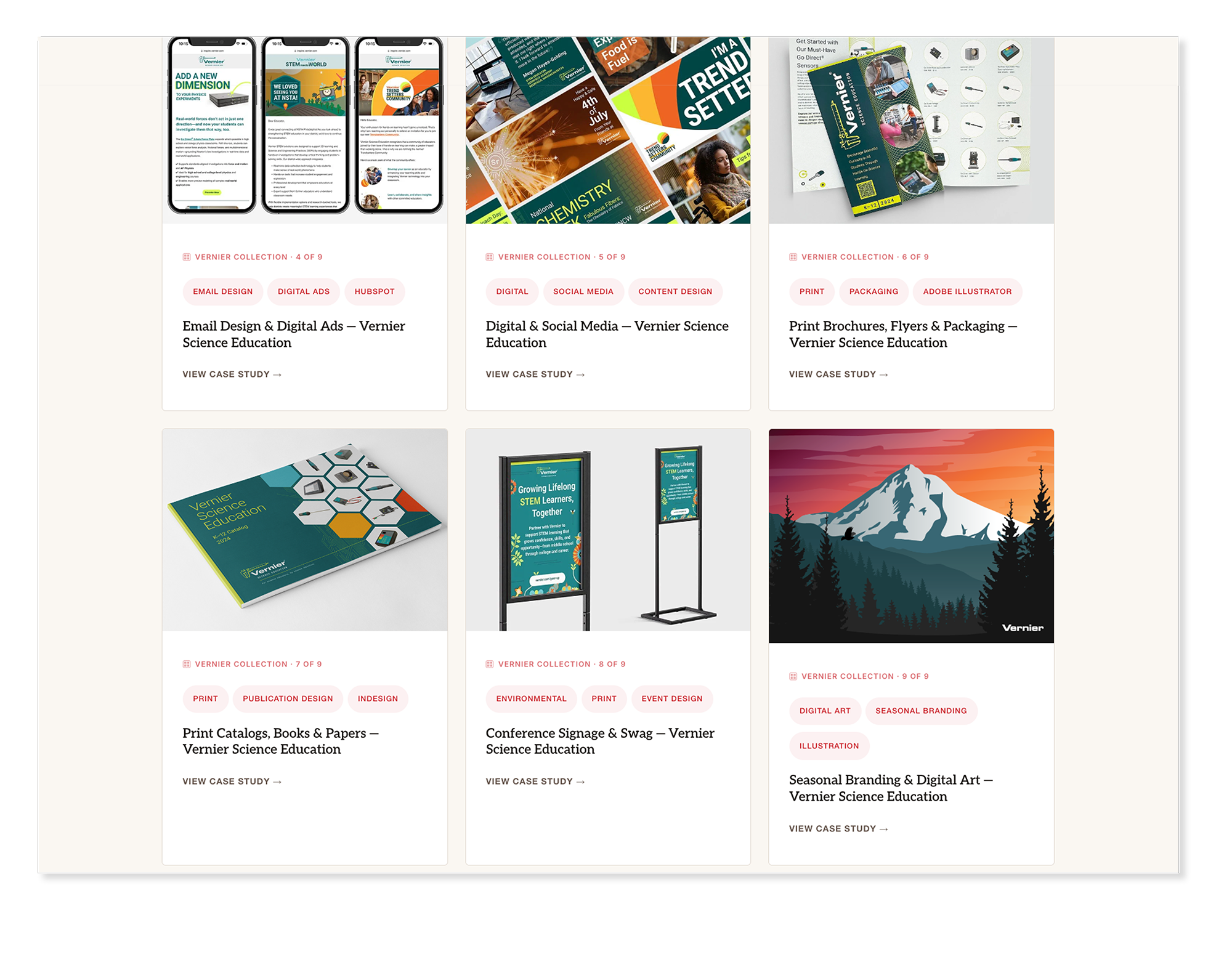
I spent six and a half years as an in-house senior designer at Vernier Science Education. In that time I worked across brand identity, campaign websites, internal web pages, email design, digital advertising, social media, print brochures and packaging, longform print publications, conference signage, and seasonal digital art.
That's nine distinct case studies. Each one tells its own story. And for a long time, I treated them exactly that way — nine separate entries on my work page, each one linking to its own page, each one standing alone.
The problem was that nobody saw them as nine pieces of a whole. Why would they? There was nothing on my site that said "these nine things are connected." A visitor who clicked into the print packaging case study had no idea that the same designer also built campaign websites, redesigned internal product pages, and created a brand guide — all for the same company, all within the same six-year arc.
The full story of what that role taught me, how it changed me, and why it matters — none of that was visible. It was scattered across nine separate pages with no thread pulling them together.
The Solution
A collection page. Not a list — a context.
The fix wasn't complicated in concept: build a dedicated landing page that exists specifically to tell the story of this body of work before a visitor dives into any individual piece of it.
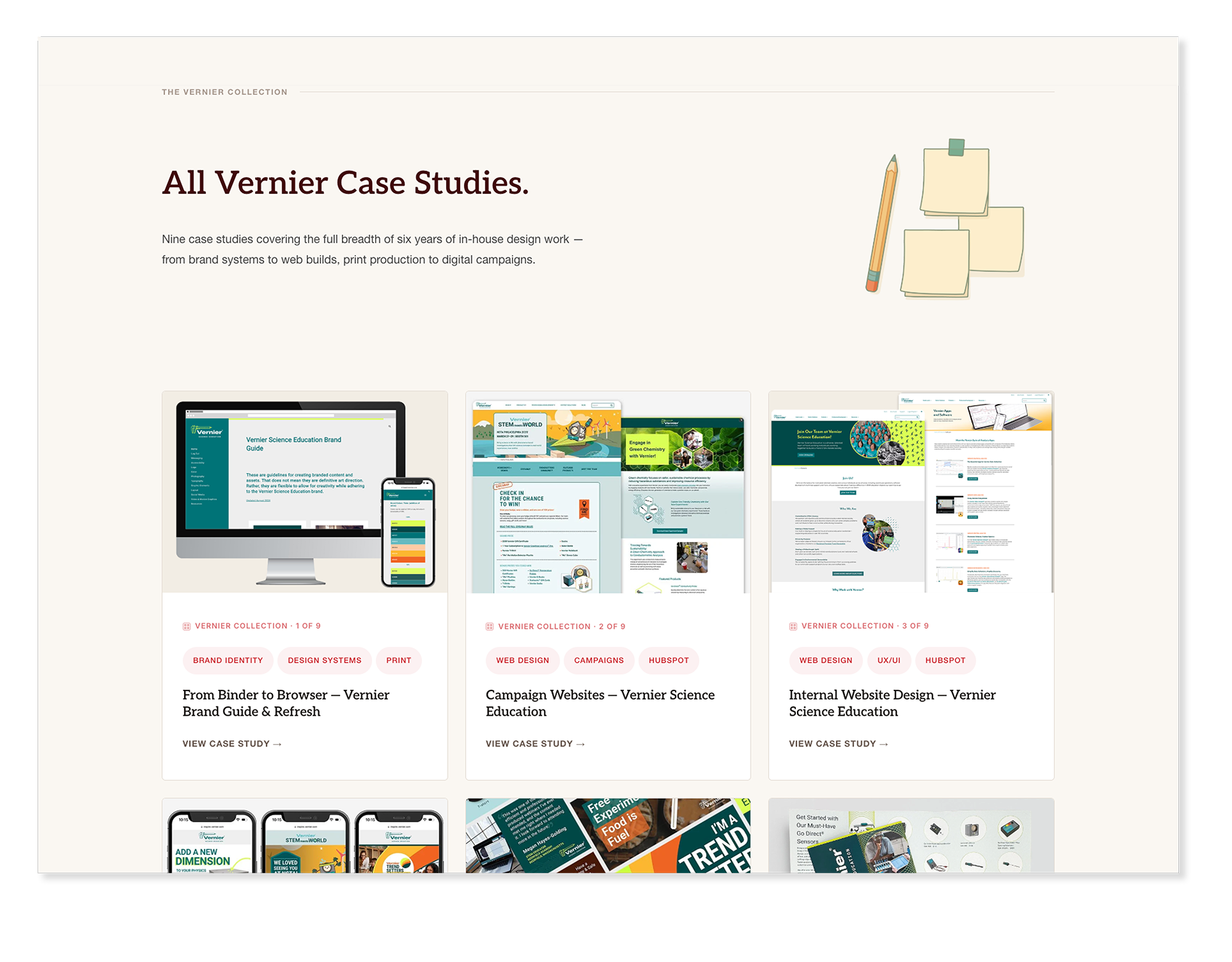
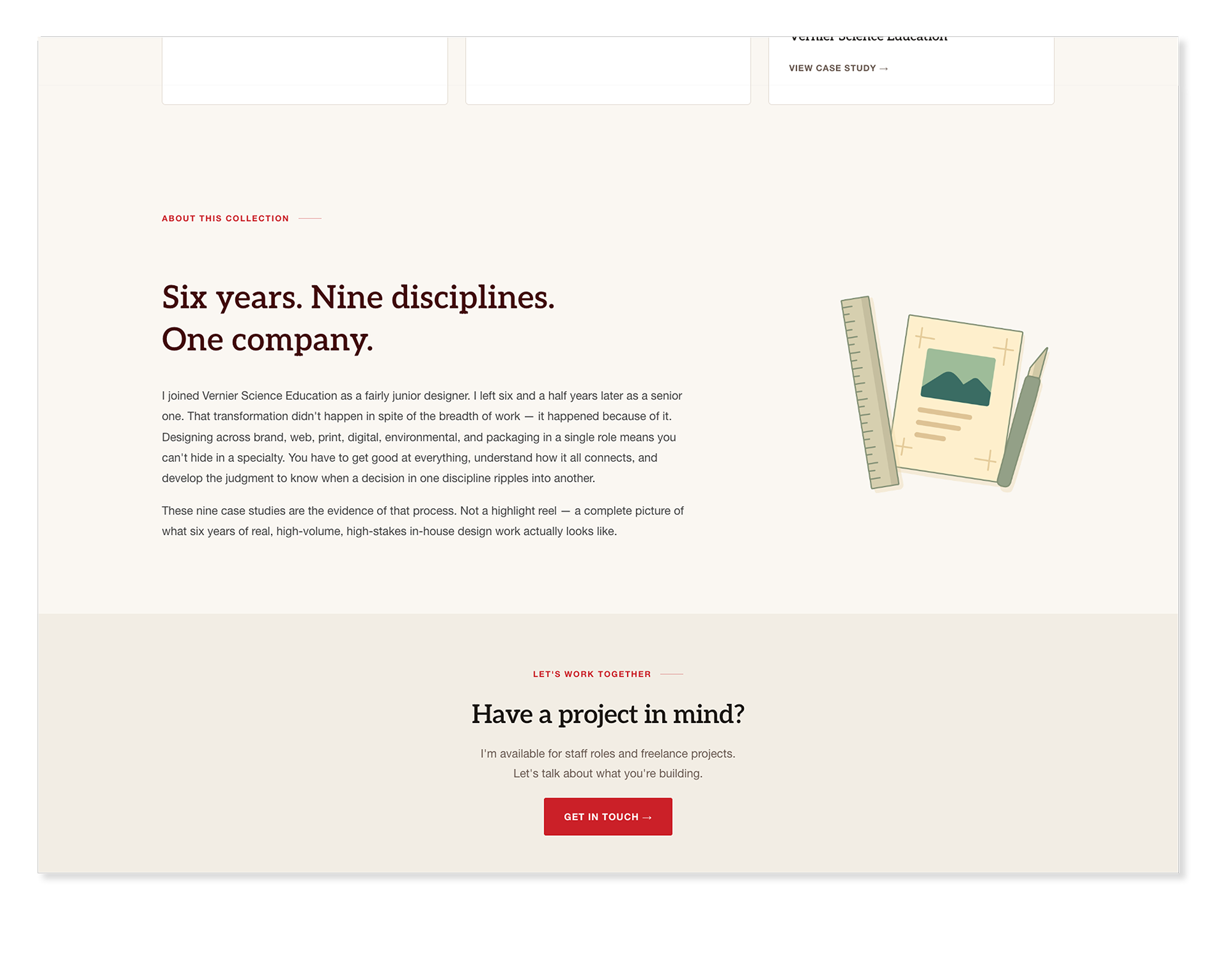
Not a list of links. Not a filtered view of the work page. A real page with a real introduction — one that says here is who this client was, here is the scope of the work, here is why six and a half years in one place matters, and here are the nine projects that came out of it. Then the grid of case studies below, each one leading deeper.
The collection page does something a case study can't: it establishes scale. It lets a visitor understand the breadth of the work before they've read a word of it. Nine cards in a grid communicates something that no single case study ever could — that this wasn't a one-off project, it was a sustained body of work that grew in depth and discipline over time.
The Detail
Why the hero changes depending on how you arrive.
Here's a small thing that turned out to matter more than I expected.
When someone clicks a Vernier case study card on my work page, they're clicking because something specific caught their eye — the brand guide, the print packaging, the campaign websites. They have a specific anticipation. If I route them straight to a generic collection landing page with no acknowledgment of what they clicked, that anticipation breaks. There's a jarring "wait, where am I?" moment before they find what they came for.
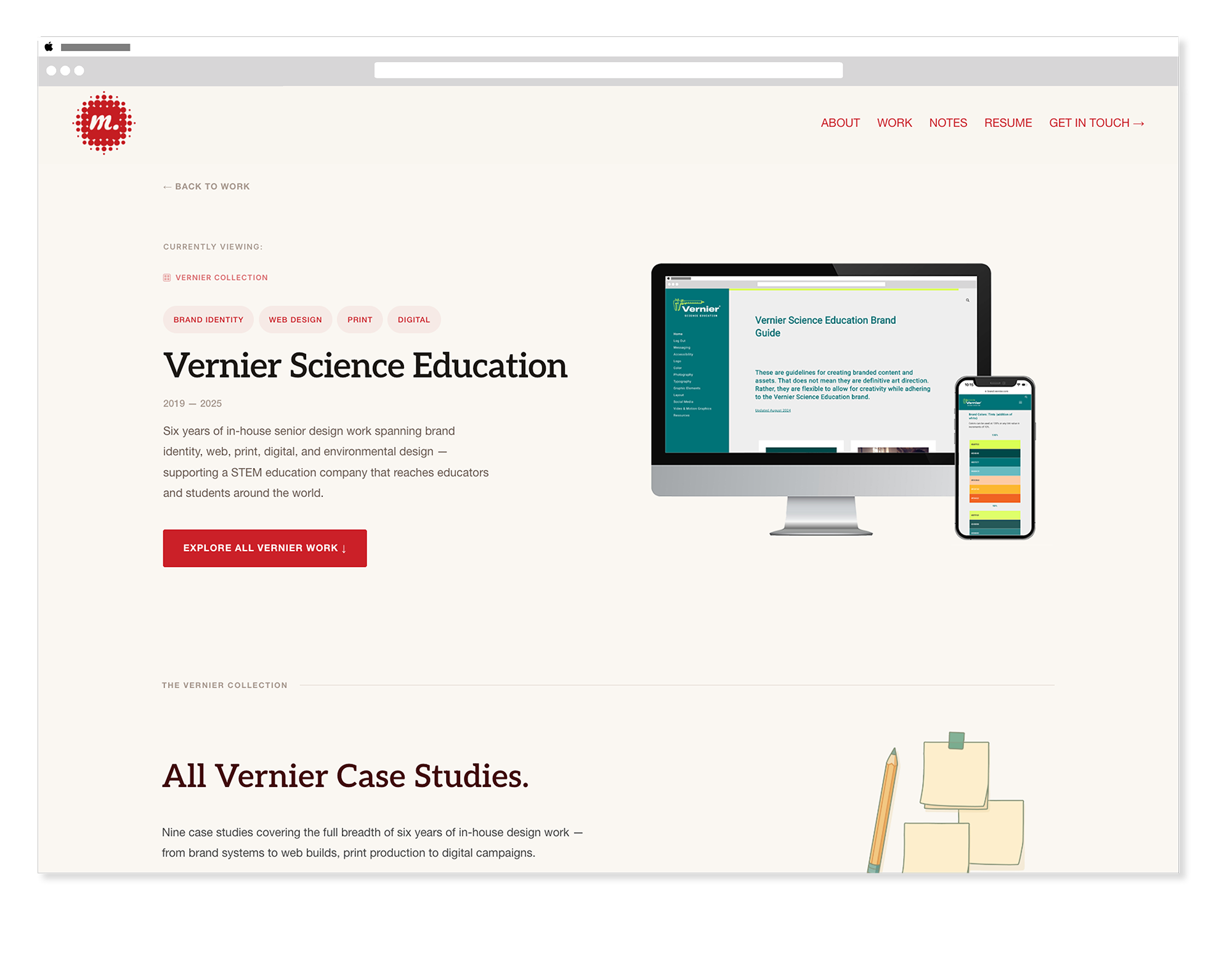
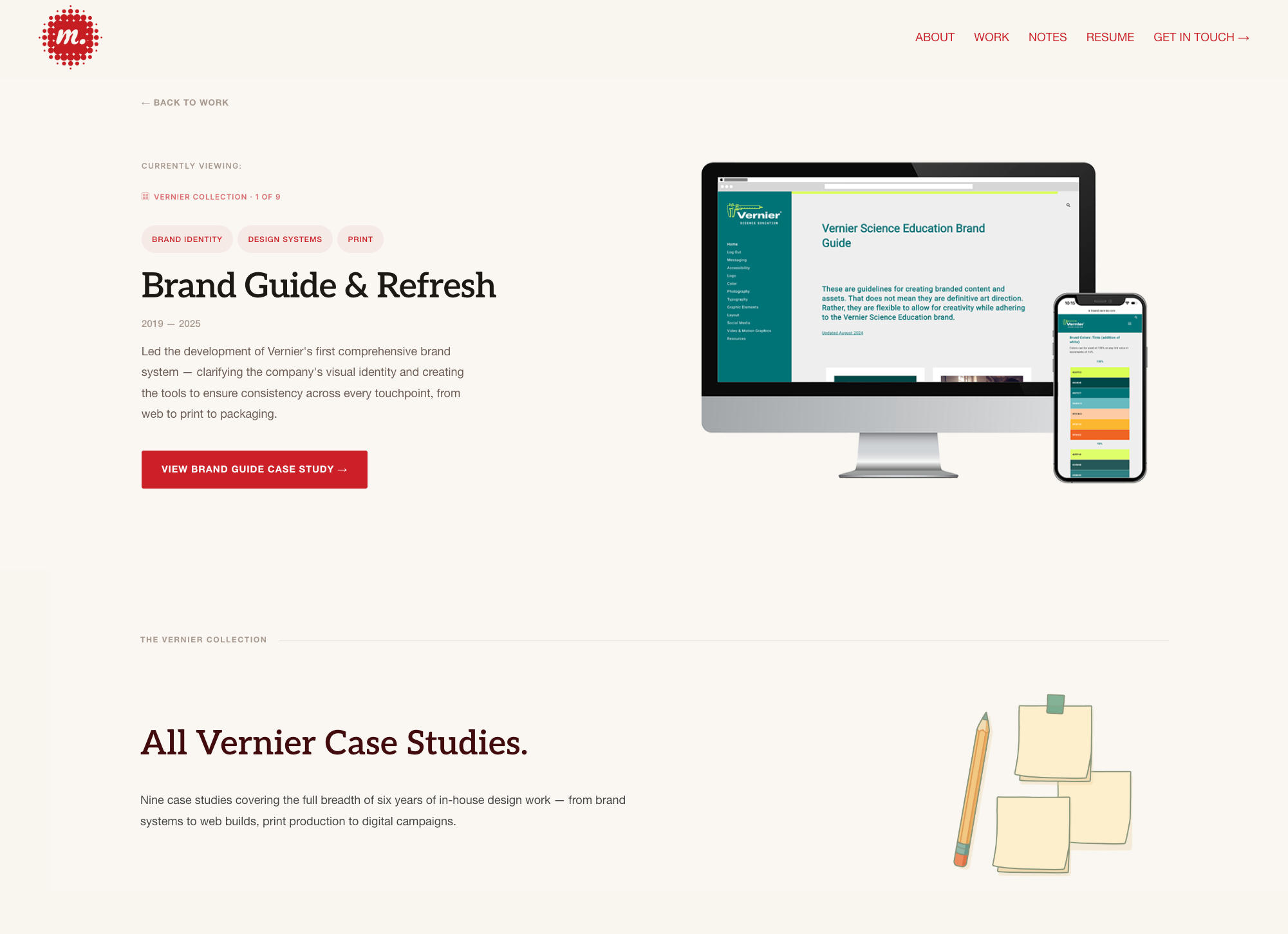
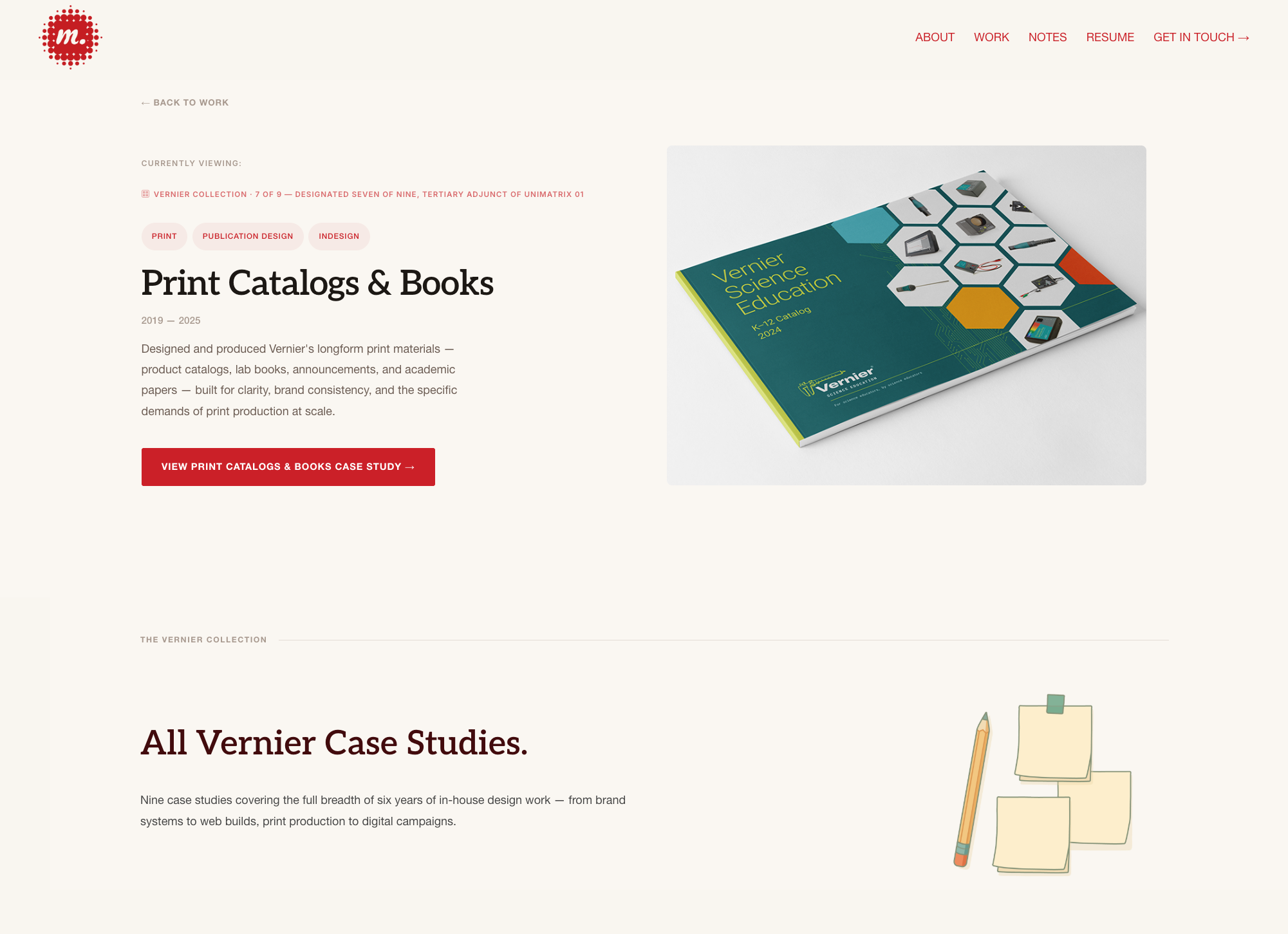
So the collection page hero changes based on what you clicked. Click the brand guide card and the hero shows the brand guide — its title, its description, its image, a direct link to the full case study. Click the print packaging card and the hero shows that instead. The page knows where you came from and greets you accordingly.
Below the hero, the full grid of nine case studies is always present. You get context for what you came for, and an immediate invitation to explore the rest.
It's a small thing technically. But the effect is significant — it maintains the momentum of a click rather than interrupting it, and it makes the collection page feel like a destination rather than a detour.
Brand Guide Hero
Print Hero
Who This Is For
This isn't just a designer problem.
I've been talking about portfolio case studies because that's my context. But the underlying problem — a body of related work that doesn't tell its own story — isn't unique to designers.
Photographers who've shot extensively for one client or in one genre. Writers with a body of work in a single subject area. Developers with multiple projects built on the same platform or for the same industry. Consultants who've worked deeply with one type of organization. Anyone whose work has a throughline that isn't visible when the pieces are presented separately.
If you have a collection of work that shares a context, a client, a discipline, or a period of time — and if that shared context is part of what makes the work meaningful — then a collection page might be exactly what's missing from how you present it.
The question to ask yourself is simple: would someone who saw all of this work together understand something they couldn't understand from any one piece of it alone? If the answer is yes, you probably need a collection page.

The Takeaway
Your portfolio isn't just a collection of projects. It's an argument for who you are.
The best portfolios don't just show work. They make a case. They take everything you've done and arrange it in a way that answers the question a potential client or employer is actually asking — not "what have you built?" but "who are you as a designer, and why should I trust you with this?"
Individual case studies answer the first question. Collection pages answer the second. They give shape to a body of work that would otherwise just be a list — and they let you tell the story of how that work made you who you are, in a way that no single project ever could.
I spent six and a half years at one company getting good at nine different things. A collection page is the only way to show all of that at once. And showing all of it at once is the only way to tell the real story.
