Sharp Design for Sharp Editors: An Updated Website for Publications Professionals LLC
UX/UI Design | Web Design | Responsive Layouts | WordPress | Front-End Design | Visual Hierarchy
UX/UI & Website Design | 2017-2025
INTRODUCTION
Publications Professionals LLC Website Redesign
Publications Professionals LLC, often called Pubs Pros, is a woman-owned, veteran-owned small business with a long history of editorial excellence. The company has built a strong reputation for high standards, attention to detail, and lasting client relationships across the publishing industry. Their dedication to quality made this collaboration both exciting and meaningful to me as a designer.
I partnered with Publications Professionals LLC to redesign and modernize their website, focusing on improving usability, accessibility, and visual hierarchy. This was a real client project and a live site launch, not a student exercise. I was responsible for translating their established credibility into a digital experience that reflects their professionalism and approachable tone. Working closely with the founder, I refined the structure, optimized navigation, and created a responsive interface that better serves their clients and team.
ROLE
LEAD WEB DESIGNER, UX/UI DESIGNER
TIMELINE
2022-2025
TOOLS
WORDPRESS, PHOTOSHOP, ILLUSTRATOR
CLIENT COLLABORATION WITH COMPANY FOUNDER & PRESIDENT
TEAM
DELIVERABLES
UX/UI DESIGN, WORDPRESS DEVELOPMENT, RESPONSIVE LAYOUTS, ACCESSIBILITY IMPROVEMENTS, DESSIGN SYSTEMS
WEBSITES
OVERVIEW
What is Publications Professionals?
Publications Professionals LLC is an editorial services company that supports publishers, nonprofits, associations, and corporations with expert editing, proofreading, and production management. Their team brings decades of experience and a reputation for precision, collaboration, and professionalism.
When the company’s original website began to feel dated and had a couple security issues, I was brought on to lead a full redesign focused on clarity, usability, trust, and accessibility. My goal was to create a site that would reflect their credibility while improving how clients navigate their services and understand their expertise.
This project became an opportunity to apply my UX and UI design process to a live client environment. From evaluating content structure and user flow to creating responsive layouts and implementing updates in WordPress, I was responsible for guiding the digital transformation from start to finish. The result is a cleaner, more intuitive experience that highlights the trust and quality at the core of Publications Professionals’ brand.
PROBLEM
An outdated site was limiting usability and client trust.
When I began working with Publications Professionals, their WordPress site was experiencing frequent hosting issues and felt outdated in both design and functionality. Navigation was cluttered, accessibility was limited, and editing content on the back end was cumbersome for the client. These problems affected not only how potential clients perceived the company but also how the team managed their digital presence.
THE BRIEF
“How could we redesign and rebuild the Publications Professionals website to create a more stable, accessible, and user-friendly experience for both visitors and potential clients?”
The initial redesign began as a response to persistent server and compatibility issues, but it quickly grew into a full rethinking of the site’s structure and design system. After researching alternative hosts and WordPress themes, I selected one that allowed greater flexibility for customization and long-term scalability.
Once the site was migrated and rebuilt, my focus shifted toward improving usability and content flow. I streamlined navigation, prioritized clear typography, and established consistent styling that aligned with the company’s professional tone. This phase not only solved immediate technical problems but also created a stronger foundation for ongoing maintenance and future growth.
DISCOVER & DEFINE
Setting project goals and defining the redesign scope.
When I first received the Publications Professionals website from the IT manager, it was clear that the site needed more than a quick technical fix. The visual design was dated, navigation lacked hierarchy, and the overall user experience didn’t reflect the company’s credibility. Before starting any design work, I took time to clarify project expectations, establish goals, and identify the tools and constraints for development within WordPress.
-
I began by performing a full audit of the existing website, including content structure, navigation flow, and visual hierarchy. I also tested the site on multiple devices to assess responsiveness and identify accessibility gaps. This helped me pinpoint the technical and UX issues that needed immediate attention.
-
The main goal was to modernize the design while improving site stability and usability for both visitors and the internal team. I also needed to ensure the redesign supported future scalability, allowing new content and features to be added easily without breaking the layout or theme structure.
-
Because this was a small team, I worked directly with the company founder to confirm priorities and define timelines. We set clear checkpoints for feedback, hosting transitions, and design approvals. This direct communication kept the project on track and built trust early in the process.
Gaining insight through competitive and content analysis.
Before finalizing the design direction, I conducted a competitive review of editorial and professional service websites. I wanted to understand how similar companies communicated credibility, handled service descriptions, and guided users to contact or inquiry forms. This research helped shape both the layout and the tone of the redesign.
-
I noted that the most effective sites used straightforward navigation and clear visual hierarchy to communicate trust and expertise. I adapted those patterns into wireframes that emphasized simplicity and readability, with content blocks designed to highlight services and experience.
-
I compared accessibility practices across competitor sites, including color contrast, text sizing, and link visibility. The findings guided my decision to adopt a minimalist color palette and larger typographic scale, improving legibility across all devices.
-
I looked at how editorial brands balanced professionalism with warmth and adapted that into the Publications Professionals redesign. The updated interface uses more white space, refined typography, and subtle visual cues to reflect the company’s reputation for clarity and attention to detail.
DESIGN & PROTOTYPING
Working within limits led to a focused redesign.
Time and documentation were both in short supply, so I focused on refining what already existed. I wanted to respect the familiar look of the site while solving its biggest usability issues.
My goal was to rebuild the site with a responsive foundation, improve accessibility, and create a smoother experience for visitors who wanted quick, clear information.
The redesign started by identifying what users struggled with most: finding key information without clicking through multiple pages. Once that became clear, I reorganized content to align with user goals rather than internal structure. This included simplifying navigation, restructuring the About and Careers sections, and removing dropdown menus that performed poorly on mobile.
I built a high-fidelity prototype to review layout adjustments and test visual hierarchy. Each round of feedback refined the experience further, ensuring the design worked as well on small screens as it did on desktop. The process was lean, but that constraint helped sharpen my decision-making and kept the focus squarely on function and clarity.
Early iterations focused on how users explored and interacted with content.
I prioritized the most important user actions first, guided by feedback and analytics that revealed where visitors dropped off or struggled to find details.
Even within a tight timeframe, I created a series of prototypes to test layout flow, navigation behavior, and the hierarchy of key information, adjusting elements until the experience felt natural and efficient.
SIMPLIFIED NAVIGATION
Streamlined the menu structure so users could quickly access high-interest pages like About and Careers.MOBILE-FIRST APPROACH
Built layouts that prioritized legibility and ease of navigation across screen sizes.IMPROVED INFORMATION FLOW
Organized content around user intent, reducing clicks and confusion across sections.HIGH-FIDELITY PROTOTYPE
Created and tested a detailed prototype to evaluate layout changes and refine visual hierarchy.
BUILD & REFINE
Building each campaign site felt like fine-tuning a living system.
After completing the design phase, I shifted focus to refining and building out the site to ensure it was both visually cohesive and technically sound.
The goal was to create a streamlined, secure, and responsive site that reflected the client’s professionalism while making it easier for users to navigate and find key information.
-
The WordPress theme I selected already included responsive layouts, which gave me a solid foundation to build from. I used the theme’s built-in mobile structure to design how the site would appear on smaller screens and made light CSS adjustments to fine-tune accessibility. These refinements helped ensure that the content remained clear, legible, and consistent across devices.
-
Throughout the build phase, I worked closely with developers, copywriters, and marketing leads to refine both design and messaging. Sometimes this meant quick feedback sessions where we made updates on the spot; other times, it meant reworking an entire layout to improve clarity. Those moments of collaboration kept the project grounded in real user needs, not just design intent.
-
Once we identified a reliable theme that supported the visual direction, I customized it through WordPress to align with the client’s brand and functional needs. I refined CSS styling to achieve a clean, editorial look inspired by professional publications, integrating subtle textures and typographic balance that suited their audience.
Testing and refining for a consistent user experience
As the build neared completion, I conducted browser and device testing to confirm performance and consistency. Each page was refined to maintain clear information flow and efficient navigation. The final site offered a simple, intuitive interface that emphasized usability without losing the polished aesthetic we had envisioned.
With these refinements in place, the site reached a balance between technical reliability and engaging user experience.
ITERATION
Refining the experience through feedback and ongoing improvements
After launching the redesigned site, I continued refining details based on client feedback and user behavior. Much of this process involved small but meaningful adjustments that improved usability and visual flow. Whether it was adjusting color contrast for readability or refining how content stacked on mobile, each update helped the site feel more natural to use.
Working closely with the client, I reviewed updates and incorporated their insights into each round of revisions. We discussed everything from content layout to image placement and continued improving areas where users hesitated or disengaged. I also kept accessibility in mind throughout, ensuring that type hierarchy, navigation, and color contrast met best practices.
These refinements built on the foundation of a customer-focused design. Publications Professionals’ audience is primarily desktop users, but maintaining strong mobile performance was just as important. If a feature worked beautifully on desktop but didn’t translate well to mobile, I re-evaluated the approach before finalizing it. This careful balance between aesthetics, accessibility, and function continues to guide my updates as the site evolves alongside the company.
FINAL DESIGN
A clean, responsive redesign built for clarity and ease of use
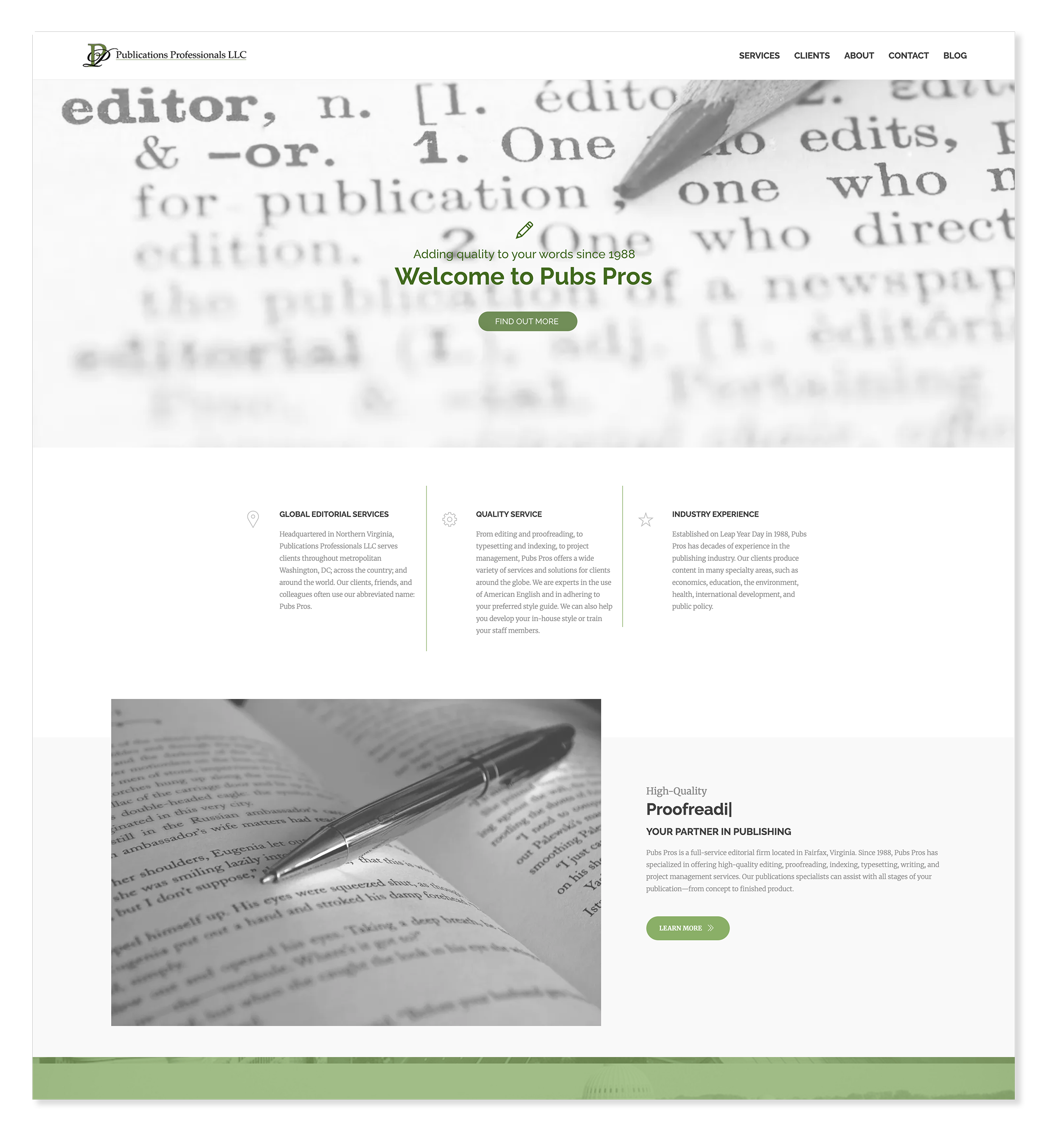
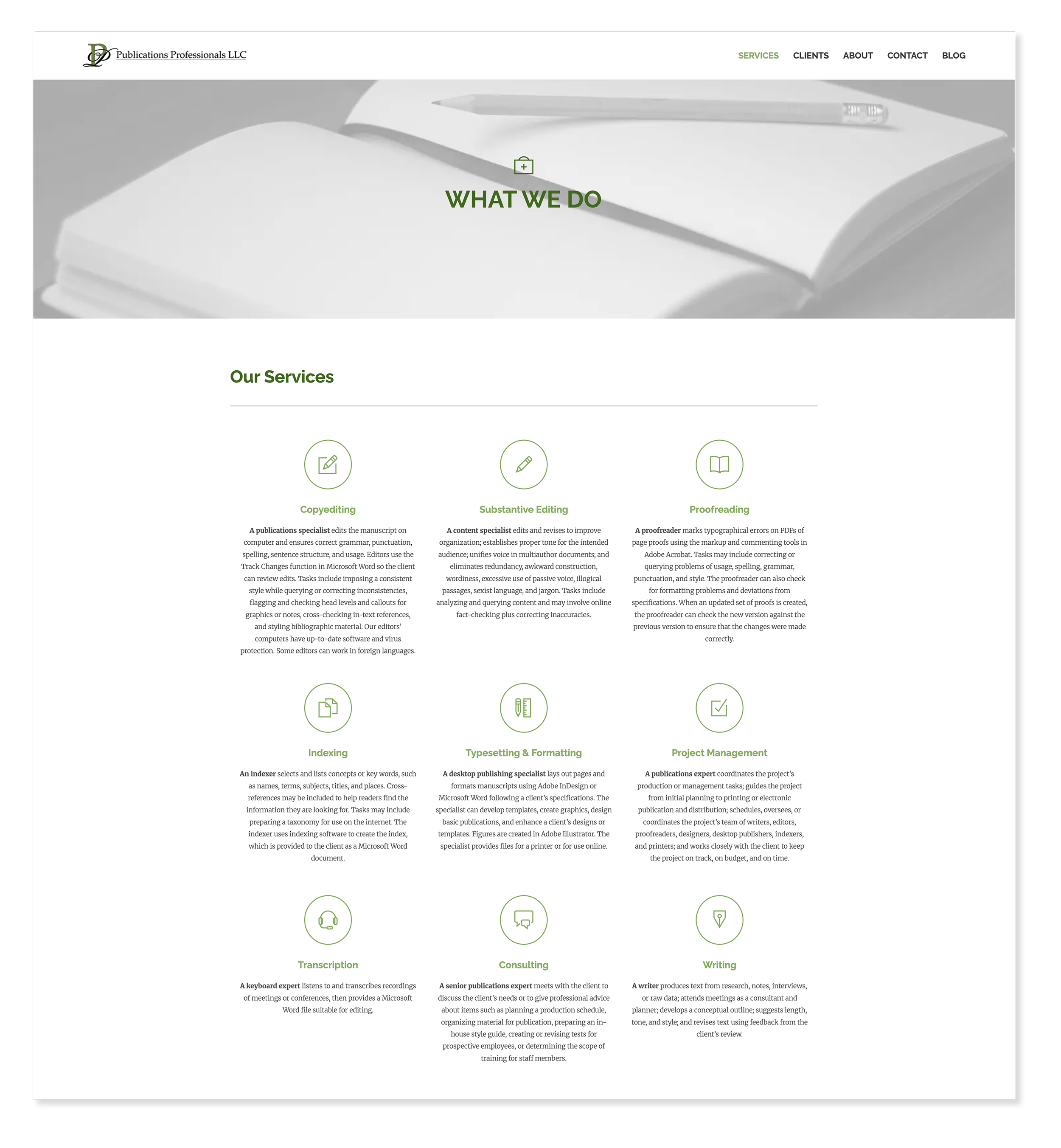
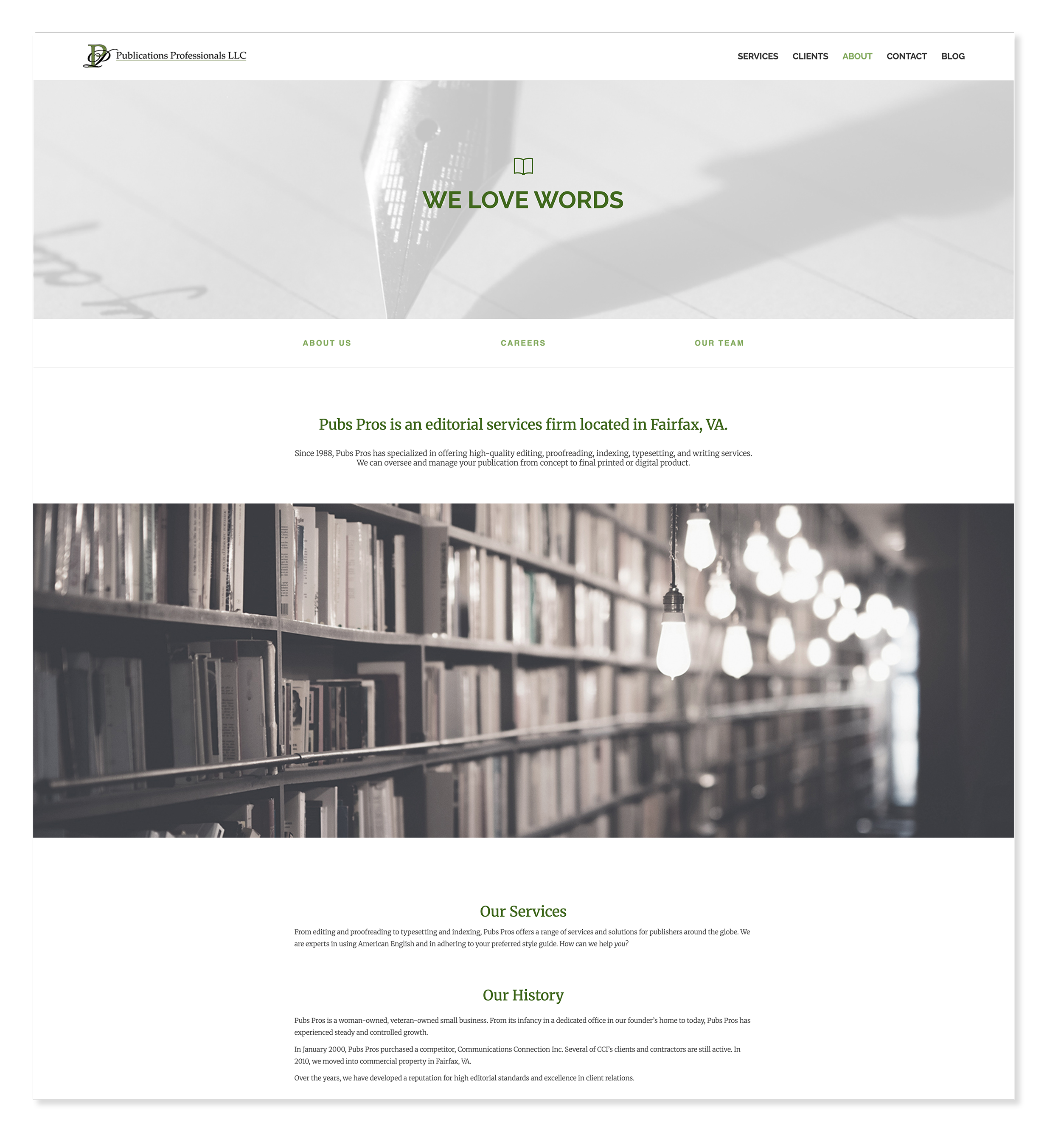
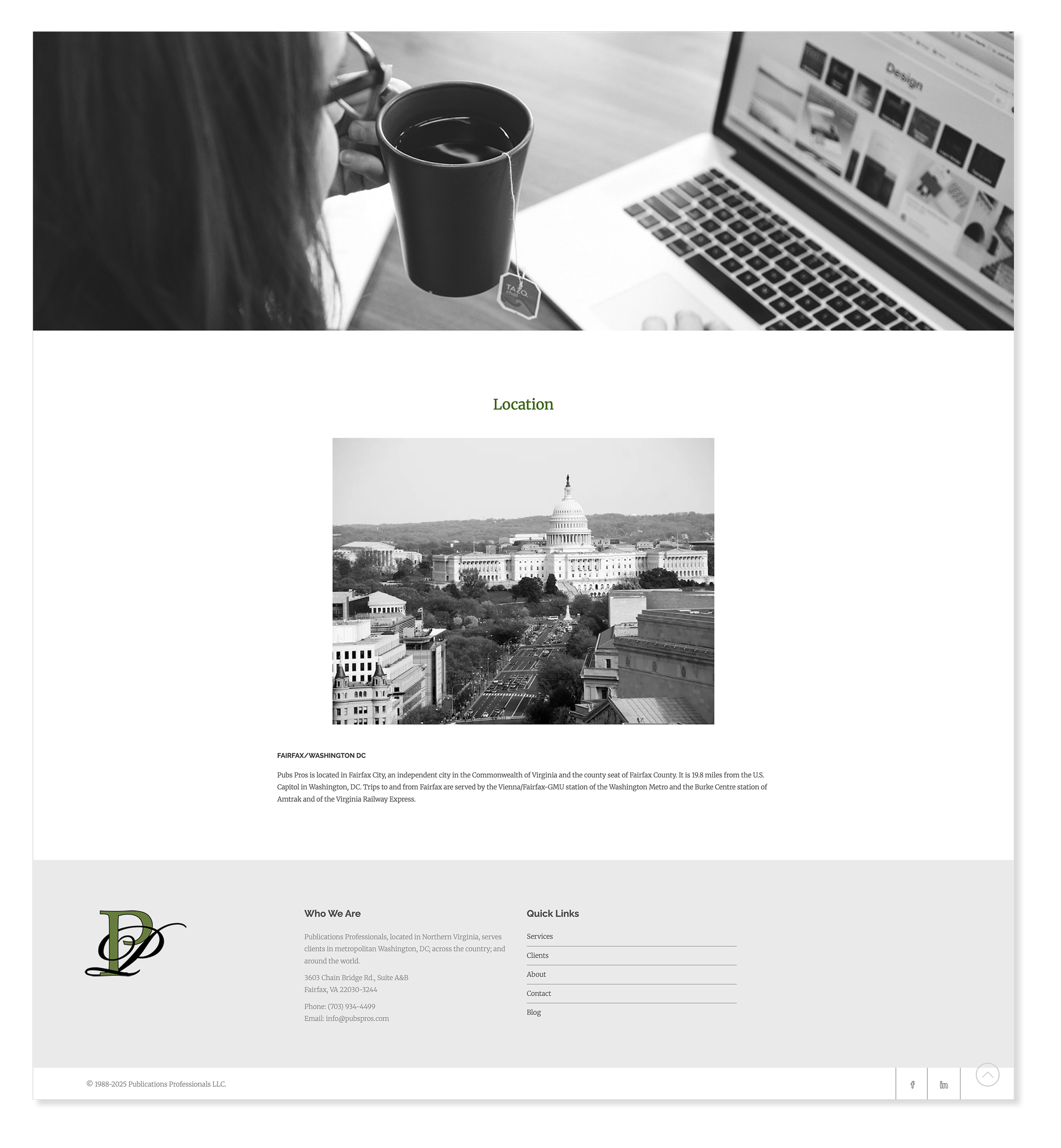
After several rounds of refinement, the final design for Publications Professionals’ website strikes a balance between professionalism and approachability. The layout highlights the company’s credibility while maintaining a visual rhythm that feels easy to navigate. Each page features clear typographic hierarchy, intentional spacing, and straightforward navigation designed to guide users naturally through the content.
The site was built around accessibility and readability. Large photography, a clean color palette, and concise text help communicate the company’s services without overwhelming the visitor. By integrating consistent design patterns and subtle interactive elements, the site now feels modern, cohesive, and representative of the quality that Publications Professionals delivers to their clients.
The final version of the site performs smoothly across both desktop and mobile devices. Navigation is intuitive, content loads efficiently, and the visual flow keeps users engaged longer. The improved responsive design ensures that text remains legible and buttons remain accessible regardless of screen size.
This redesign not only resolved the initial usability issues but also created a flexible framework for future updates. It supports the client’s evolving business needs and reflects their identity as a trusted, professional editing firm. Seeing it come together so cohesively reaffirmed my goal of creating digital spaces that feel as thoughtful and polished as the work they represent.
A. FINAL DESIGN / HOMEPAGE STRUCTURE AND VISUAL FLOW
Establishing a clear, trustworthy first impression
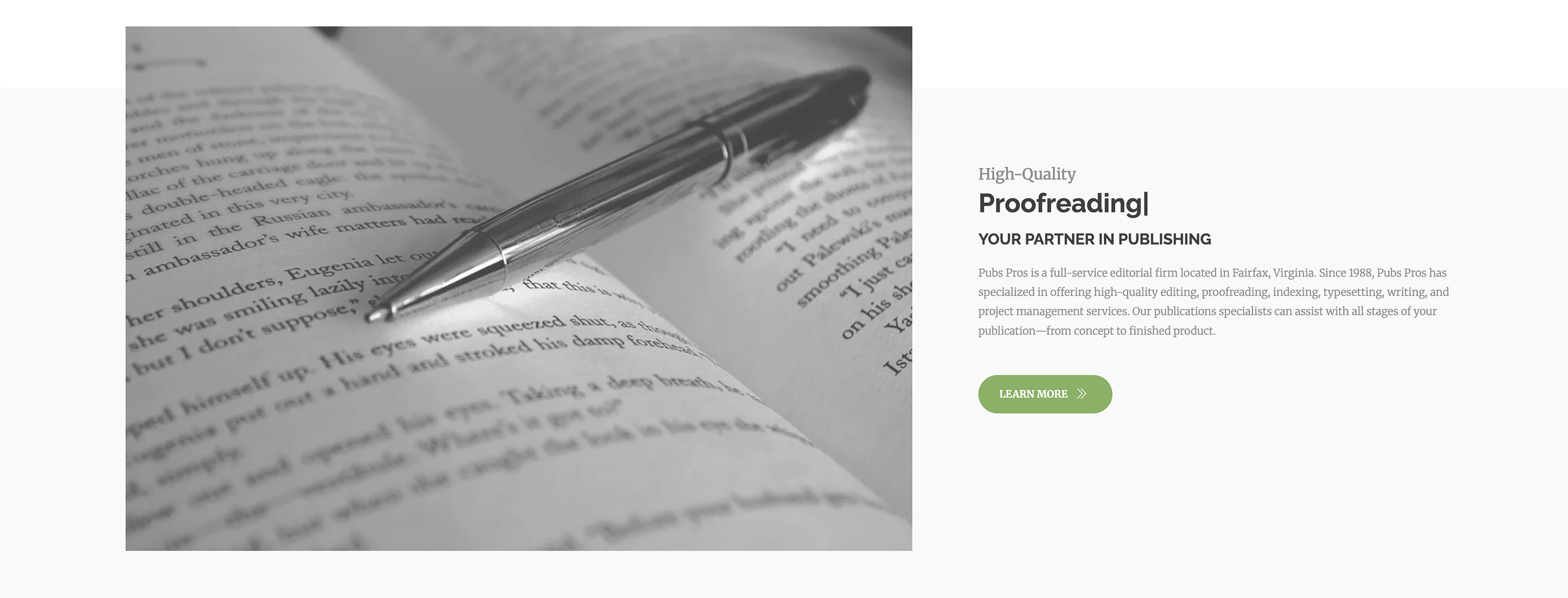
The homepage sets the tone for the entire site. From the beginning, my goal was to design a structure that immediately communicates credibility and professionalism while feeling approachable. I wanted visitors to quickly understand what Publications Professionals does and why they can trust them with their content. To achieve this, I used a strong visual hierarchy, large photography, and clear messaging paired with a logical flow of information.
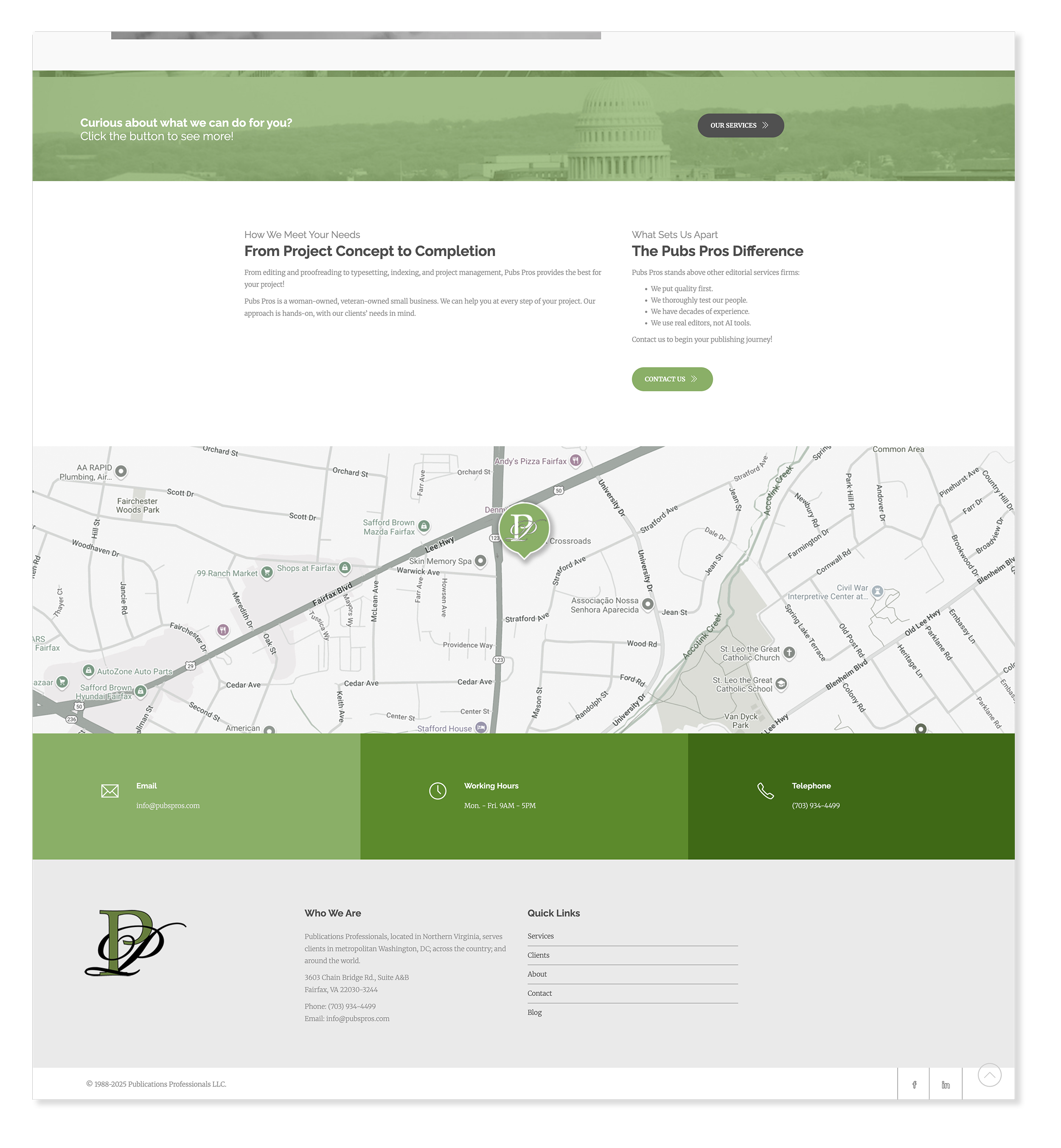
Each section was designed to guide users through a story, starting with who the company is, moving into what they offer, and ending with a clear path to contact or learn more. This intentional pacing gives users context before asking for engagement, which builds confidence and reduces cognitive load.
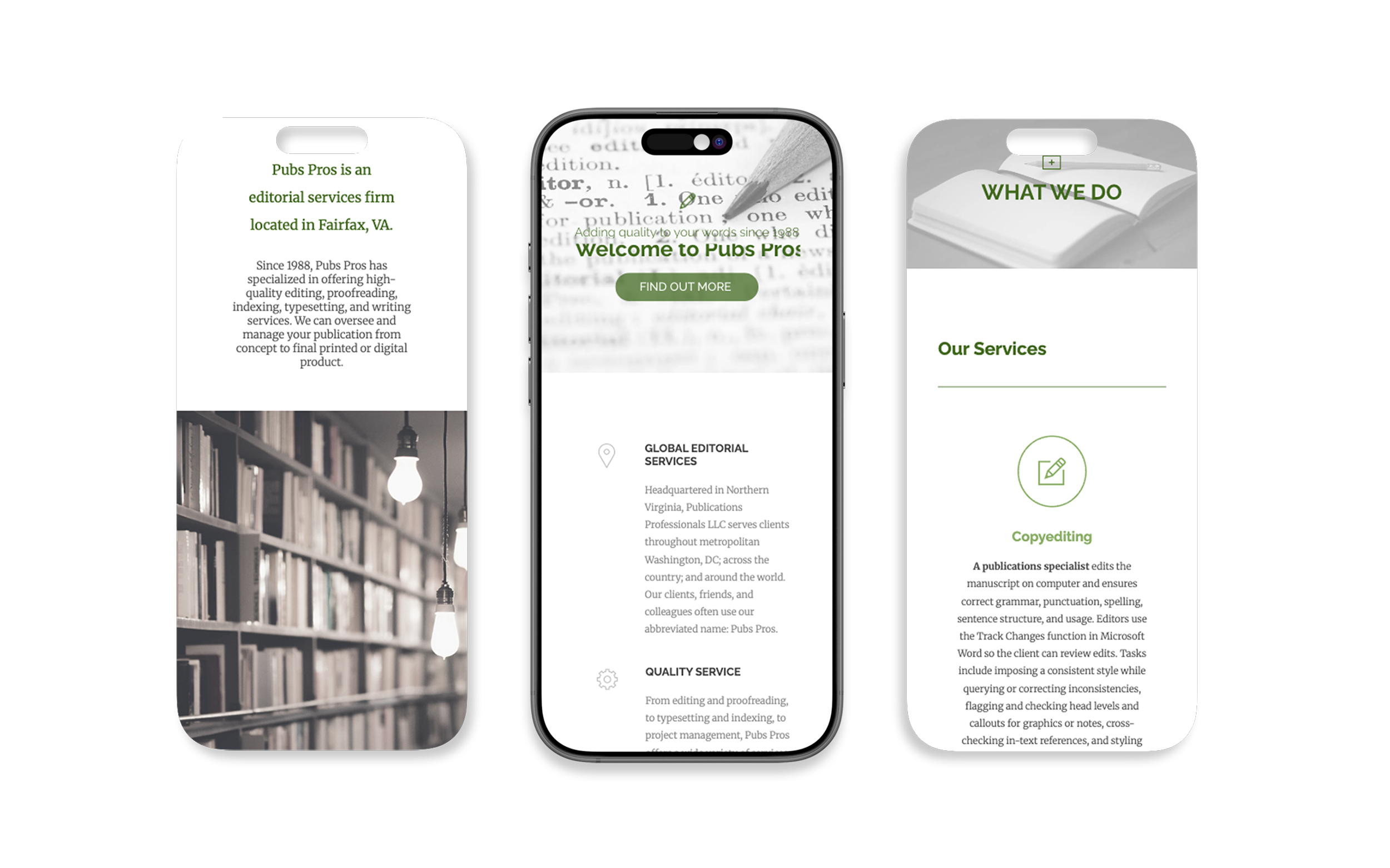
The grid system allowed me to keep layouts consistent and predictable without feeling rigid. I applied generous whitespace between elements to improve readability and create a sense of calm that fits the company’s tone. I also made sure the visual hierarchy remained clear on smaller screens by reordering certain content blocks for mobile viewing.
This approach created a homepage that feels balanced and professional. Visitors can now find essential information in seconds, which aligns perfectly with the expectations of their client base of publishers, editors, and corporate professionals. Seeing the new structure perform so efficiently was a small but satisfying reminder of how much design clarity can impact user confidence.
B. FINAL DESIGN / RESPONSIVE DESIGN
Adapting for mobile and beyond
Designing for different devices is an exercise in balance. Each layout needs to feel natural on a phone, tablet, or desktop without losing the brand’s integrity or visual rhythm. For this project, I worked within WordPress’s built-in responsive layouts to refine how the site adapted across screen sizes. I approached each breakpoint as an opportunity to simplify and strengthen the user’s experience rather than just resize it.
The framework handled most of the scaling, but I used targeted CSS adjustments to fine-tune visual hierarchy and maintain accessibility. Buttons were resized for touch, text spacing was improved for legibility, and spacing was recalibrated to support quick scanning on smaller screens. These subtle refinements helped the design feel cohesive across devices, ensuring users could navigate confidently whether they were exploring from a desktop or a phone.
This project reinforced how small details add up when designing responsively. I found that anticipating how content shifts or compresses helps prevent friction later in development. It also gave me a chance to evaluate how imagery and typography contribute to usability, not just aesthetics. By treating mobile design as an extension of the experience rather than an afterthought, I created a layout that felt flexible and intentional.
Working within WordPress’s limitations required creative problem-solving, but that constraint pushed me to prioritize clarity and simplicity. The result was a structure that supported accessibility and responsiveness in equal measure, staying true to both the design and the user’s needs.
C. FINAL DESIGN / UX/UI DESIGN
Visual consistency and user flow
Creating a cohesive interface is as much about restraint as it is about creativity. For this project, my goal was to make the UI feel familiar, intuitive, and aligned with the brand’s visual language. I focused on creating consistency across buttons, links, and form fields, while maintaining flexibility for content that changed from page to page. Establishing a clear visual rhythm helped users understand what to expect and where to go next.
I built a design system that included color, typography, and spacing standards, which guided everything from headline styles to subtle hover effects. This approach gave the interface a unified look and feel that supported both usability and brand identity. Small touches like consistent corner radii and alignment cues helped create a sense of polish that made the experience feel intentional and refined.
Testing the design across devices and browsers highlighted how even small visual inconsistencies can impact trust and engagement. I refined spacing, adjusted contrast levels, and refined iconography to ensure that the interface remained clear and accessible. These adjustments not only improved the user experience but also strengthened the overall presentation of the brand.
Looking back, this example represents a balance between creative expression and practical design thinking. Every visual decision had to support clarity, not just aesthetics. The process reminded me that a successful UI doesn’t call attention to itself, it guides users seamlessly through the experience with subtlety and purpose.
OUTCOME
Building trust through transparency and collaboration
“Our beautifully designed website by Meghan has increased visitors and has definitely made a positive impact on our business.”
—Barbara Hart, CEO & Founder, Publications Professionals LLC
Since launching, the website has been well received by both Publications Professionals and their visitors. It elevated their online visibility and positioned the company as a trusted source for publishing services. The improved structure and refreshed visual design made the site easier to navigate and more engaging for potential clients, which helped strengthen their professional reputation.
Working on this project reminded me how essential open communication is in design partnerships. When challenges came up, being honest and offering clear solutions helped build trust and led to better decisions for the business. That collaborative process shaped a stronger outcome for both sides and made the project deeply rewarding.
REFLECTION
Evolving a living design over time
This project has grown alongside both Publications Professionals and myself. Since the redesign launched, I have continued to refine and improve the site as their needs evolve. Each update has given me an opportunity to strengthen both the visual experience and the usability of the platform. It has also reinforced how important it is to view websites as living systems that require ongoing care, attention, and thoughtful iteration.
SMALL REFINEMENTS MAKE A BIG IMPACT
Even subtle changes, like increasing font sizes and adjusting spacing, can dramatically improve accessibility, readability, and SEO performance.CONSISTENCY SUPPORTS CREDIBILITY
Maintaining a consistent brand experience across new pages and updates has helped reinforce trust with visitors and present the company as a polished, professional partner.COLLABORATION BUILDS BETTER RESULTS
Regular communication with the Publications Professionals team ensures that each update reflects both their business goals and their personality as editors and storytellers.
This project reminded me that design success does not end at launch. Continuous improvements, no matter how small, can have lasting impact. I plan to keep refining this site as the business grows, making sure each change feels intentional and supports both the user experience and the company’s evolving story.