
What If a Video Game Could Teach You History? — An Interactive Multimedia Project
A six-month PCC multimedia final project exploring the intersection of video games and historical education — a fully interactive, animated website with 25 screens, 2 videos, and 3 original music tracks, built entirely from scratch.

A question that started with a video game and became a six-month project.
Playing through Assassin's Creed II, something unexpected happened — I started retaining Italian phrases. The subtitles were in English, the dialogue in Italian, and the repetition of specific words and landmarks across hours of gameplay lodged them firmly in memory. It wasn't a classroom. It wasn't a textbook. It was a video game. And it was working. That observation became the seed of this project: if repetition and immersive context are keys to learning, and video games deliver both in abundance, what does that mean for how we think about historical education? The MM 140 final project gave me the space to explore that question seriously — and the result was the most ambitious thing I had built to that point.
The Problem
Can a video game teach you history — and can a multimedia project prove it?
Learning history through video games isn't a new concept, but it's an underexplored one. The challenge of this project was twofold — make a compelling academic argument for game-based historical learning, and then demonstrate it through the design and execution of a fully interactive multimedia experience that was itself engaging enough to hold a visitor's attention.
The choices that shaped the experience.
Choosing Assassin's Creed as the lens.
Assassin's Creed was the natural anchor for this project — it's one of the most historically ambitious game franchises ever made, with development teams that include historians and archaeologists as consultants. Using it as the primary case study gave the project both credibility and a rich visual library to work with. The series also spans multiple historical periods and geographies, which allowed the project to explore the thesis across different contexts rather than a single narrow example.
Organizing around Historical vs. Artistic Accuracy.
One of the most interesting tensions in historical game design is the relationship between what's accurate and what's compelling. Assassin's Creed makes deliberate choices about both — sometimes prioritizing historical fidelity, sometimes taking creative liberties for the sake of narrative or gameplay. Structuring the project around that tension gave it a natural argument to make, and gave visitors something to think about beyond just the surface-level content.
Going far beyond the minimum requirements.
The course required at least 5 screens of interactivity. The finished project had 25. Every screen was animated. There were 2 videos and 3 pieces of music. The decision to exceed the requirements wasn't about grades — it was about doing justice to a subject that genuinely excited me. When you care about the topic, the scope tends to expand naturally. Seeing it through to completion was one of the most satisfying experiences of my time at PCC.
Building in Edge Animate with hand-coded HTML, CSS, and JavaScript.
Edge Animate was the tool of the course, but the interactivity and polish came from pushing it further than its defaults — layering in jQuery and JavaScript to handle navigation, sound, and animation states that Edge Animate alone couldn't deliver. The MM 110 + 120 courses had built the foundation; MM 140 was where all of it came together in a single project that was genuinely complex to build and genuinely satisfying to finish.

Twenty-five screens of history, animation, and interactivity.
The project began with a moodboard and written concept document in MM 110 + 120 — setting the stage before a single screen was designed. From there, six months of research, design, animation, and coding produced a fully interactive multimedia experience that exceeded every course requirement by a significant margin.
Concept & Moodboard
Adobe Illustrator Adobe PhotoshopThe project started with written research and a moodboard — fleshing out the thesis, identifying the visual direction, and establishing the structure before any interactive screens were built. This foundation kept the six-month build focused and intentional.
Home & Navigation
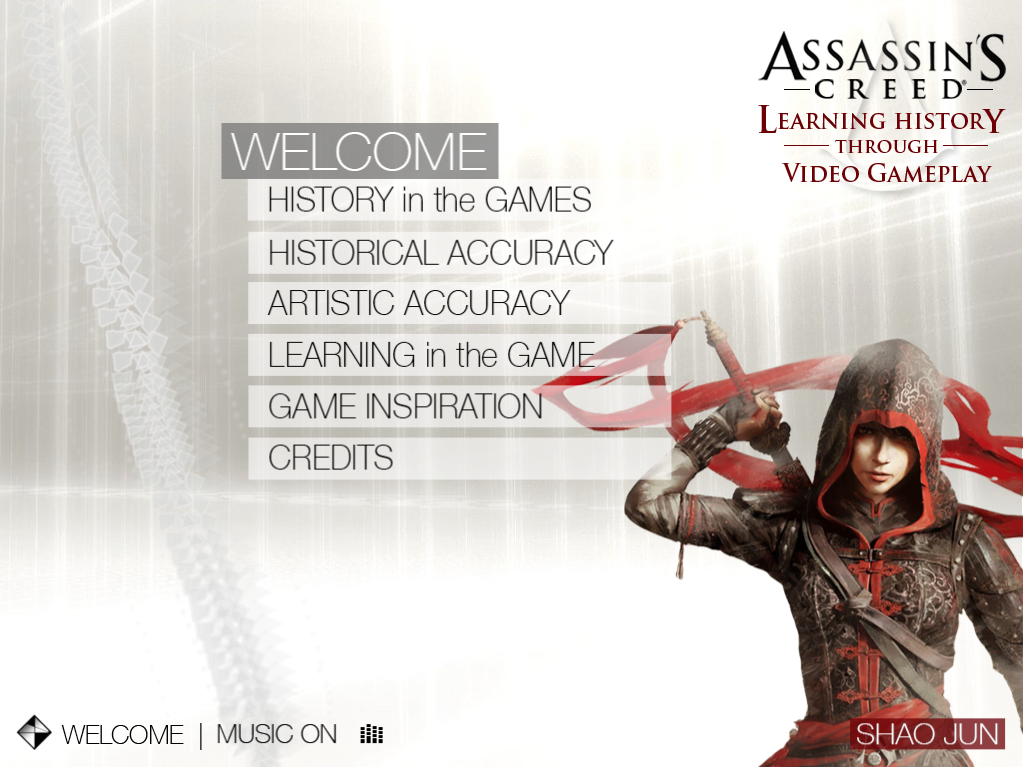
Edge Animate HTML & CSSThe home screen and navigation system set the tone for the entire experience — dark, atmospheric, and immediately immersive. Every screen was reachable from the main menu, with animated transitions between sections keeping the experience cohesive.

Historical Accuracy
Edge Animate JavaScriptThe historical accuracy section explored how Assassin's Creed represents real locations, events, and figures — and where it diverges from the historical record for narrative purposes. Research into the Italian Renaissance and Middle Eastern settings of the early games gave this section its depth.

Artistic Accuracy
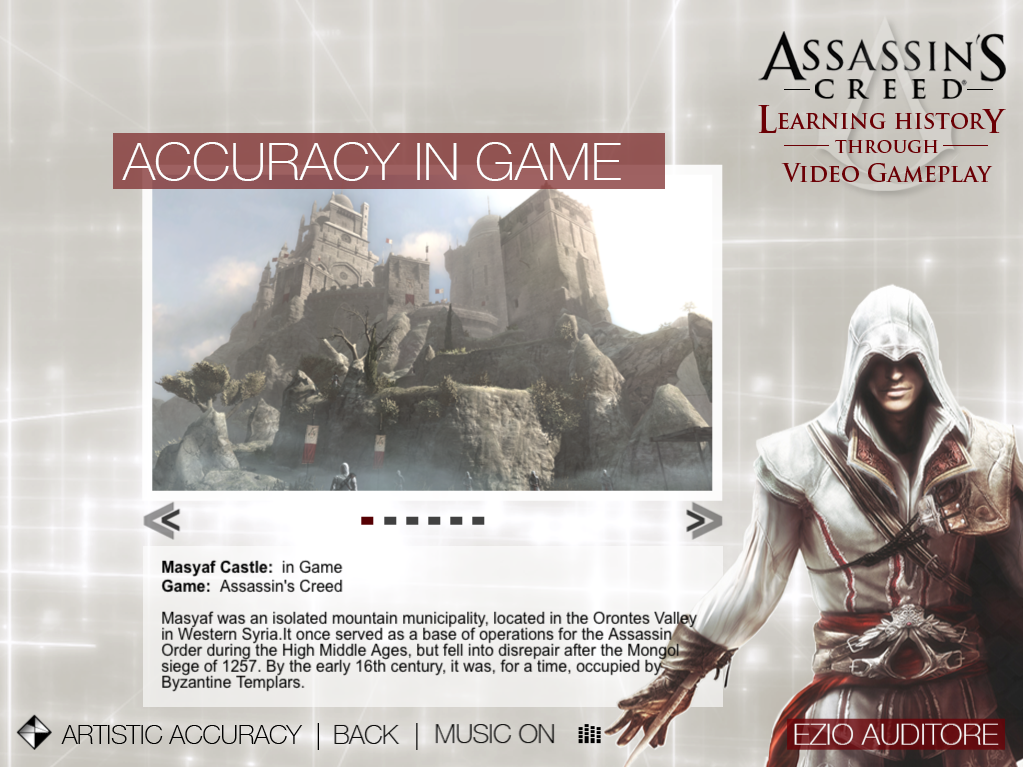
Edge Animate Adobe PhotoshopAlongside historical accuracy, the project explored how the games represent art, architecture, and visual culture of their respective periods — and how that artistic authenticity contributes to the learning experience even when the historical narrative takes liberties.

Factions: Assassins & Templars
Edge Animate jQueryThe faction pages explored the historical roots of the Assassins and Templars — real organizations that the games draw from and reimagine. These sections were among the most research-intensive of the project, connecting fictional narrative threads to documented historical movements.


“I went in to play a game. I came out knowing things about Renaissance Italy I hadn't known before — subtitles on, controller in hand, accidentally learning Italian. Nobody told me to pay attention. The design just made it impossible not to.”
Meghan Lewis, Senior Visual DesignerA student project that became a portfolio piece.
Required: 5. Delivered: 25 — every single one animated, with clickable navigation throughout.
Three pieces of music accompanied the experience — required: 1. Sound played throughout every section of the project.
From initial concept in MM 110 + 120 through final delivery in MM 140 — six months of research, design, animation, and coding.
Six months, twenty-five screens, and a thesis I still believe in.
This was the most ambitious solo project I had undertaken at that point in my education — and finishing it was genuinely exhilarating. The subject matter wasn't assigned; it came from real curiosity sparked by a personal experience with a video game. That made every hour of research feel worthwhile rather than obligatory. The technical challenge of pushing Edge Animate beyond its defaults, layering in jQuery and JavaScript to get the interactivity I needed, was exactly the kind of problem-solving that made the work feel meaningful.
The thesis itself — that video games can be legitimate vehicles for historical learning — still holds up. Repetition, immersion, and context are foundational to how people retain information, and well-designed historical games deliver all three. Assassin's Creed was the right lens for this argument, and the project gave me a way to make it rigorously rather than just anecdotally. It remains one of the pieces I'm most proud of from my time at PCC.
The idea for this project started shortly after playing Assassin's Creed II — finding myself naturally recalling Italian phrases and landmarks from the game weeks later. Understanding that repetition is one of the keys to learning, those easily recalled words and phrases became the spark for six months of work.