
Back & Better Than Ever: Rebuilding the PDXWIT Website from the Ground Up
A full website rebuild for Portland Women in Technology — bringing a returning grassroots community back online with a refreshed brand, a modern WordPress build, and a community-first experience designed to grow.
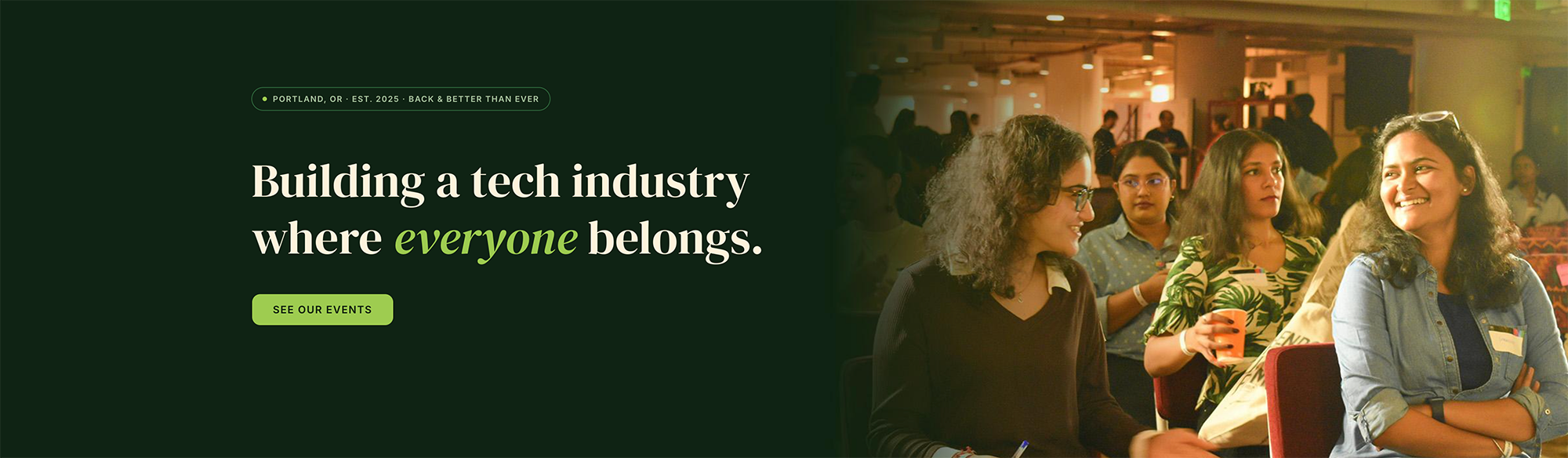
Overview
A community returning to the web — stronger, clearer, and ready to grow.
Portland Women in Technology had been off the grid for a while. When new leadership relaunched the organization in 2026, they needed more than just a website — they needed a digital home that could support an active community, communicate their mission clearly, and scale as the group grew back to full strength.
I built the new PDXWIT website on WordPress from scratch, applying a refreshed version of the original brand identity I designed in 2017–2019. The result is a fast, community-focused site with event management, a clean content architecture, and a visual system that honors where PDXWIT came from while looking firmly toward where it's going.
The build was also a meaningful mentorship experience. Athena Luna came on as a contributor and brought real initiative to the project — her wireframes sparked the early design system conversations and gave the work a strong structural foundation. I provided direct feedback throughout her process and helped her navigate the significant learning curve of translating Figma designs into Elementor, a jump that challenges even experienced designers. That collaborative dynamic shaped the project in ways I'm genuinely proud of.
The Problem
No website. No presence. No way for the community to find them.
When PDXWIT relaunched, there was no digital infrastructure to support it. No website, no event system, no way for potential members to learn about the organization or find upcoming events. The challenge was building something that could go live quickly, handle real community needs from day one, and be maintainable by a small volunteer team without a dedicated developer on call.
Key Decisions
What I decided, and why.
WordPress for maintainability, not just flexibility
With a small volunteer team and no dedicated developer, the platform needed to be something non-technical contributors could manage confidently. WordPress with The Events Calendar plugin gave us a robust, familiar CMS that the team could own without needing me on call for every update.
Evolve the original brand, don't replace it
The 2017–2019 PDXWIT brand had equity and recognition in the community. Rather than starting from scratch, I refreshed the identity — refining the logo, updating the color system for digital accessibility, and modernizing the typography — so the organization felt renewed without feeling unrecognizable.
Events first — everything else supports discovery
For a community group, events are the primary reason someone visits the site. The navigation, homepage layout, and content hierarchy were all designed to surface upcoming events immediately and reduce friction from landing to registration. Everything else — About, Blog, Contact — supports that core journey.
The Brand Revisit
Honoring the original while building for what's next.
The 2017–2019 PDXWIT brand was built to last — and it did. Seven years later, the core identity still had life in it. The revisit focused on refining for digital-first use: improving color contrast for accessibility, sharpening the logo for high-resolution screens, and updating the type system for web performance. The result feels like a natural evolution, not a departure.
Updated Logo System
2026 RefreshThe mountain mark was refined for crisp rendering across all screen sizes — from mobile favicon to desktop header. Color relationships were preserved while improving contrast ratios for WCAG compliance.

2012 — Original
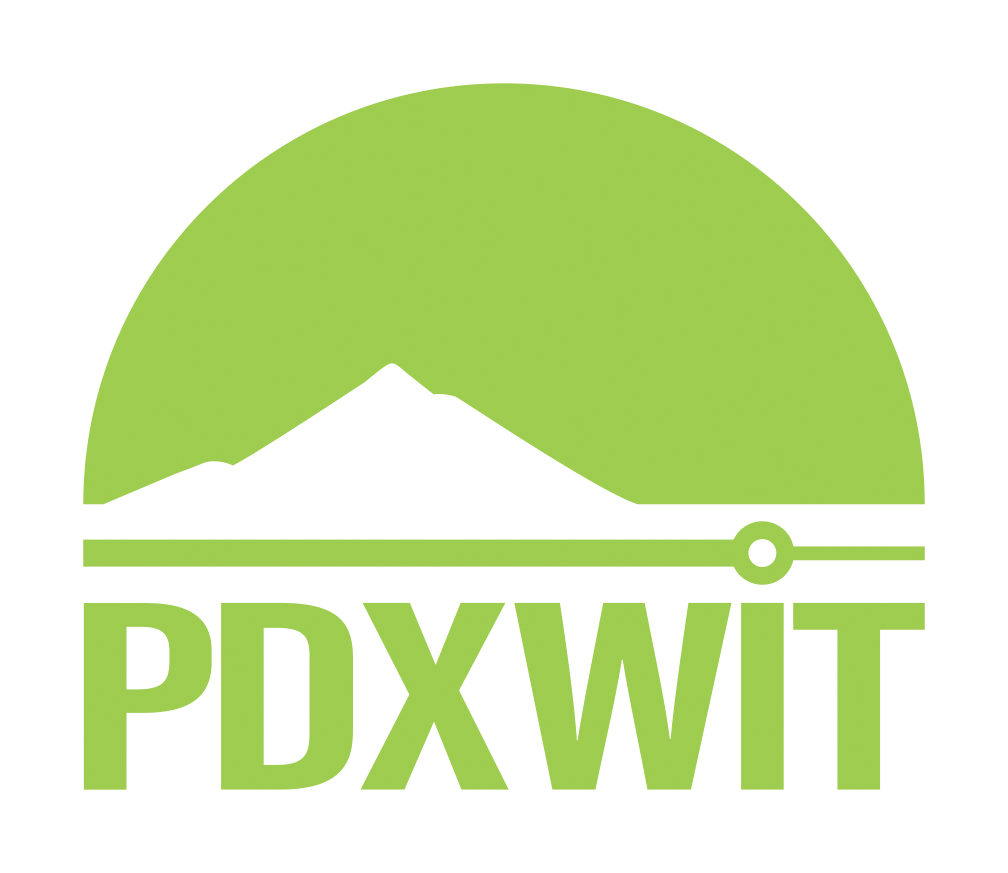
2017 — Brand Refresh

2026 — Website Refresh
Color & Typography for Web
2026 RefreshThe original earthy palette was refined and extended with digital-safe values — ensuring every color meets accessibility contrast standards on screen. Typography was updated to web-optimized Google Fonts equivalents that preserved the character of the original system while improving load performance.
Color System — 2026 Refresh
Lime Green
#9DCC4F
Forest Green
#316E40
Orange
#B86947
Rich Black
#121212
Cream
#FCF2DA
Light Grey
#EDEDED
Dark Forest
#0F2211
Typography
DM Serif Display
Headings & Display
Aa Bb Cc Dd Ee Ff — 0 1 2 3 4 5 6 7 8 9
Aa Bb Cc Dd Ee Ff — 0 1 2 3 4 5 6 7 8 9
Inter
Body & UI — Regular · Medium · Semi-Bold
Aa Bb Cc Dd Ee Ff — 0 1 2 3 4 5 6 7 8 9
Aa Bb Cc Dd Ee Ff — 0 1 2 3 4 5 6 7 8 9
"The updated PDXWIT website is exactly what the tech community needs right now."
Kellyn Pot'Vin-Gorman — PDXWITThe Pages
Every page with a purpose.
The site was architected around a clear user journey — discover the community, find events, learn more, get involved. Each page plays a specific role in that flow, designed to reduce friction and build trust at every step.
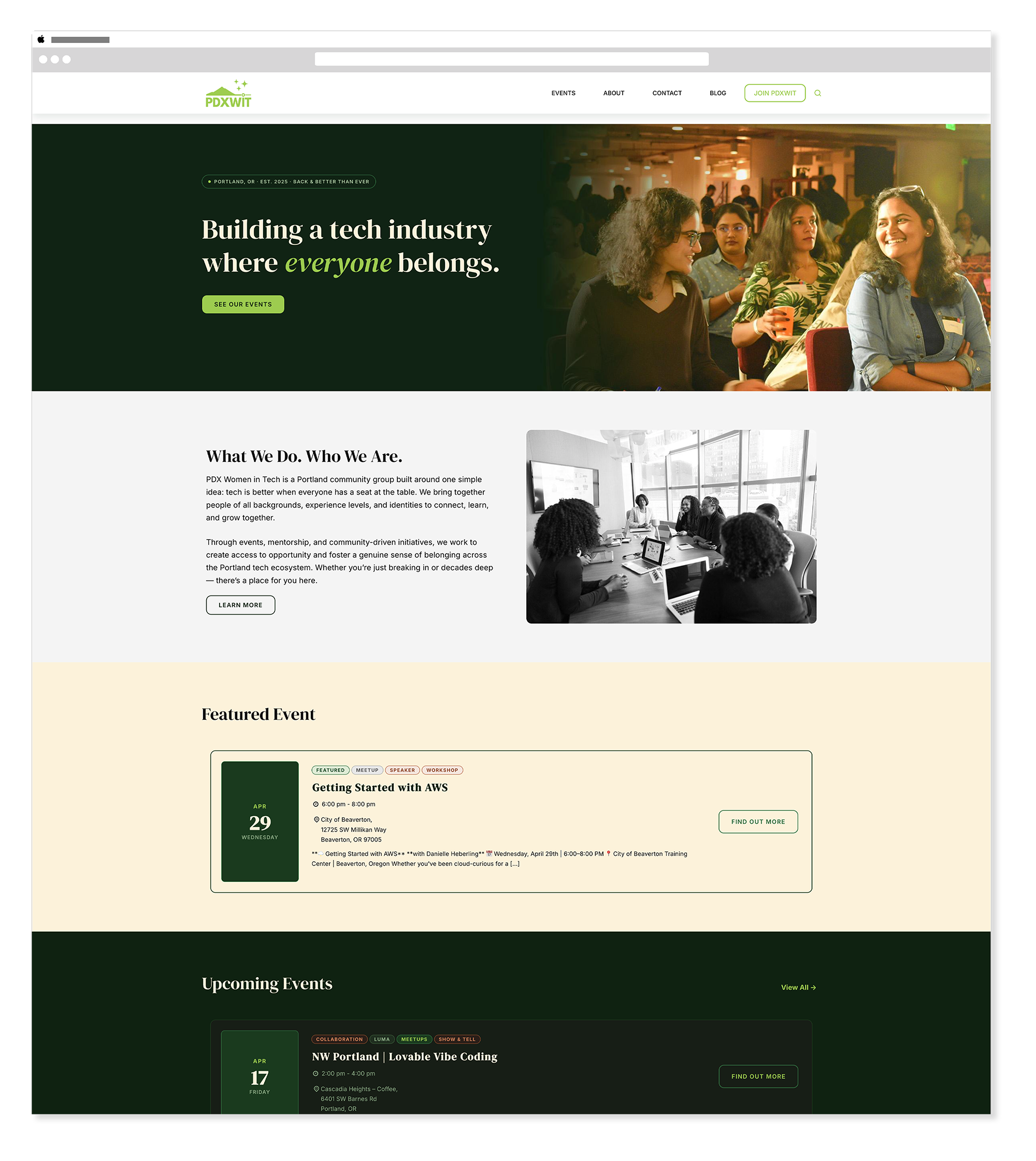
Homepage
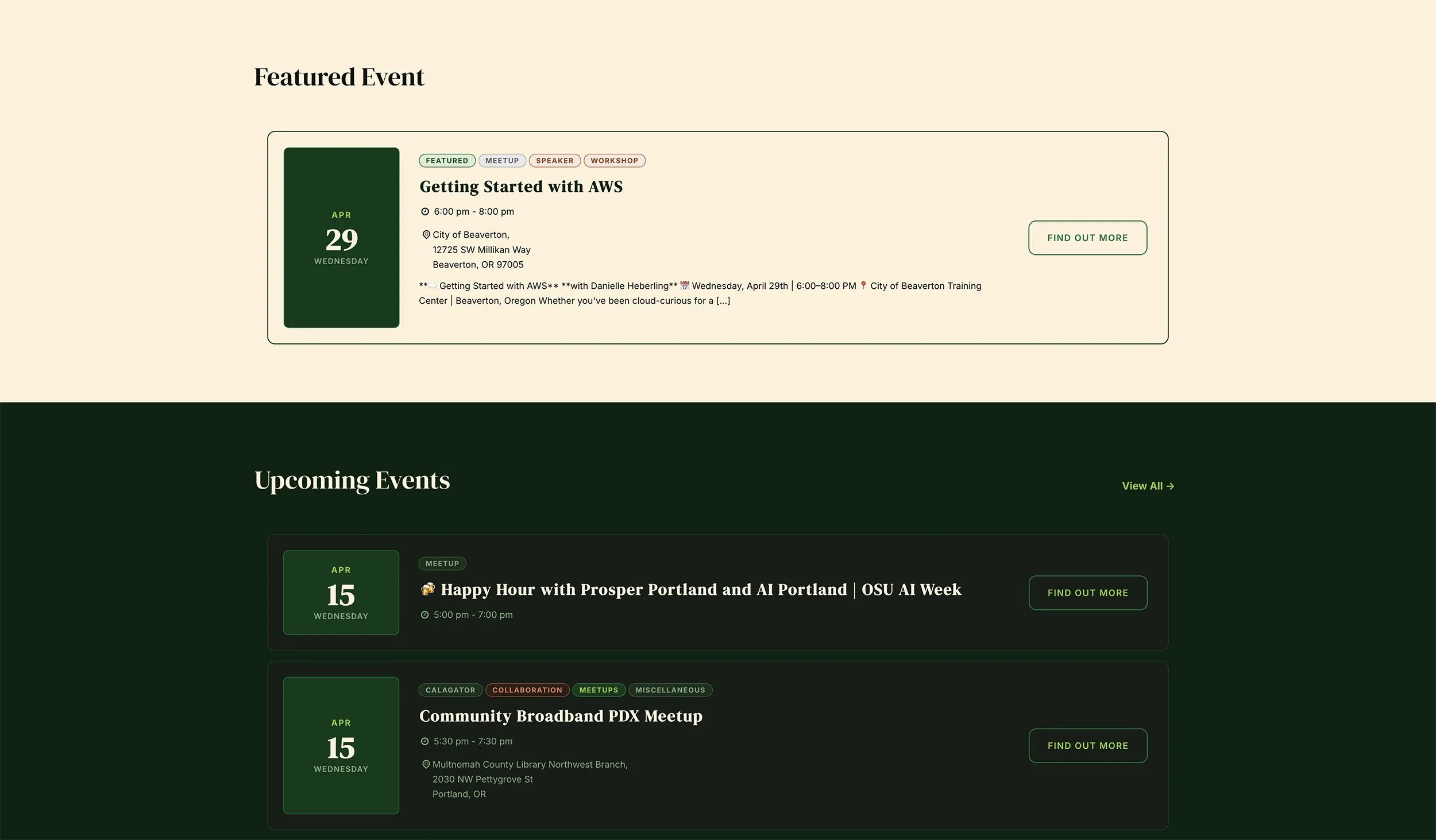
WordPress Custom ThemeThe homepage establishes PDXWIT's mission immediately and surfaces upcoming events without requiring any extra navigation. A featured event block, upcoming events list, and community CTA give visitors everything they need to take action on the first visit.
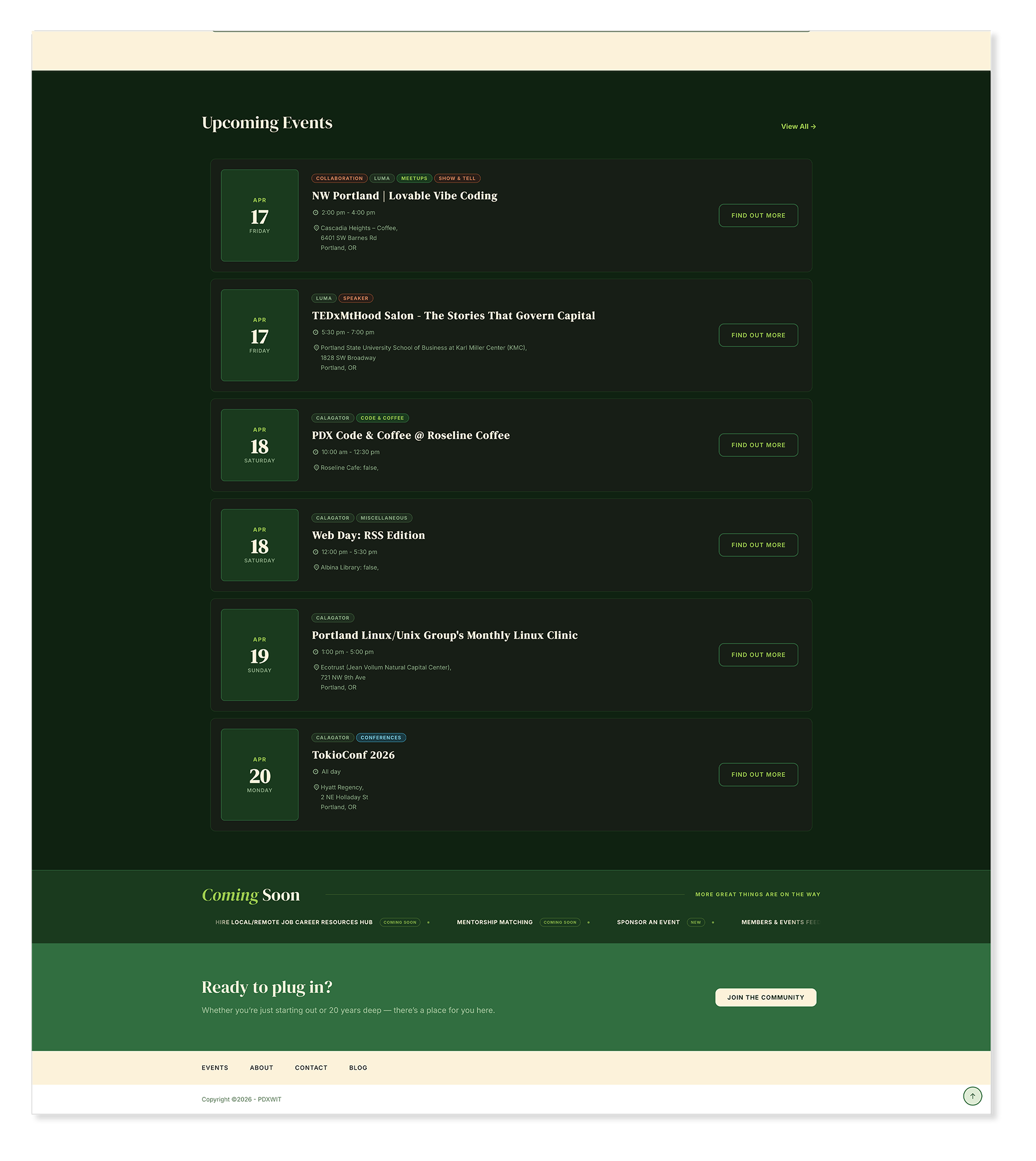
Events
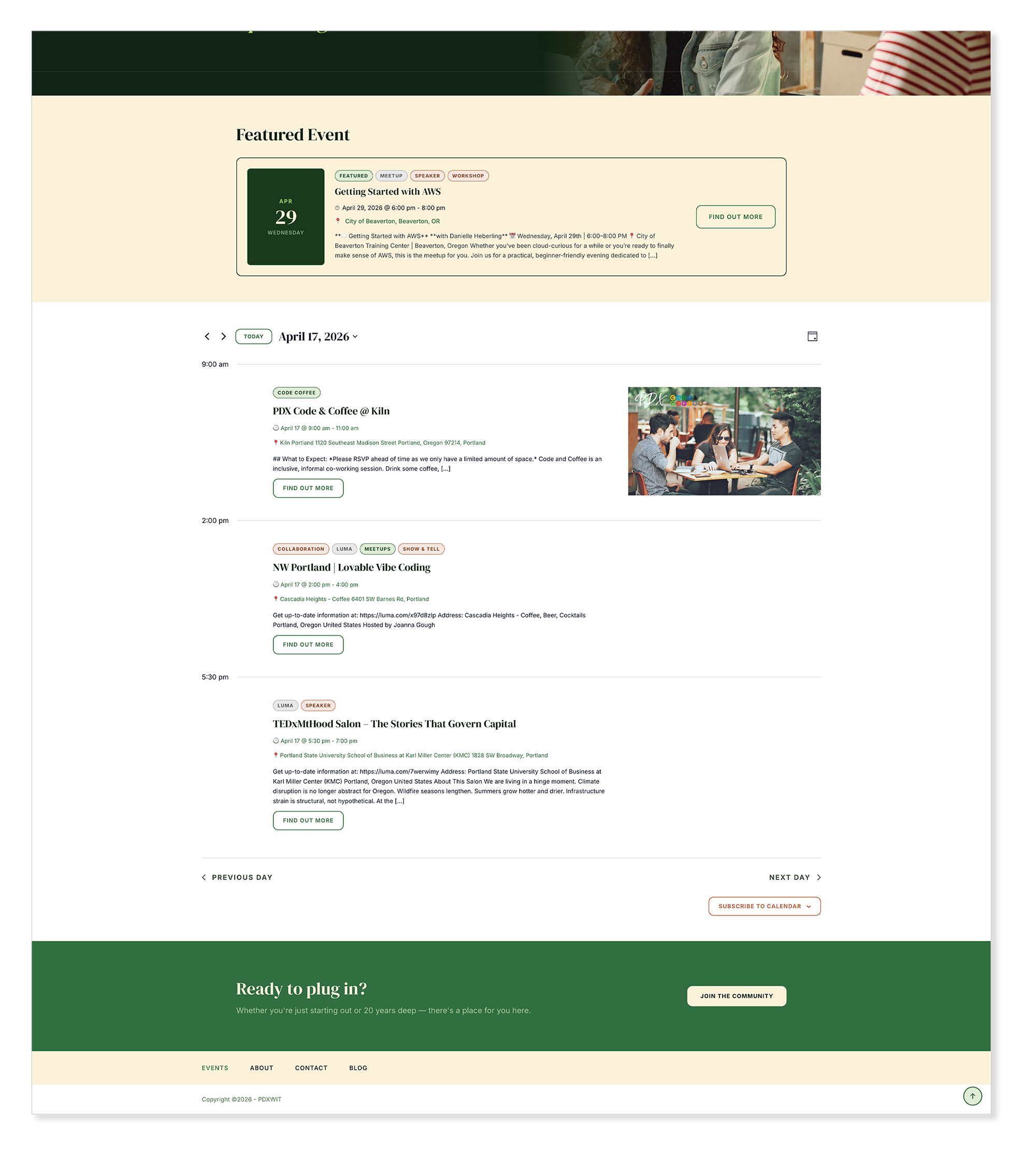
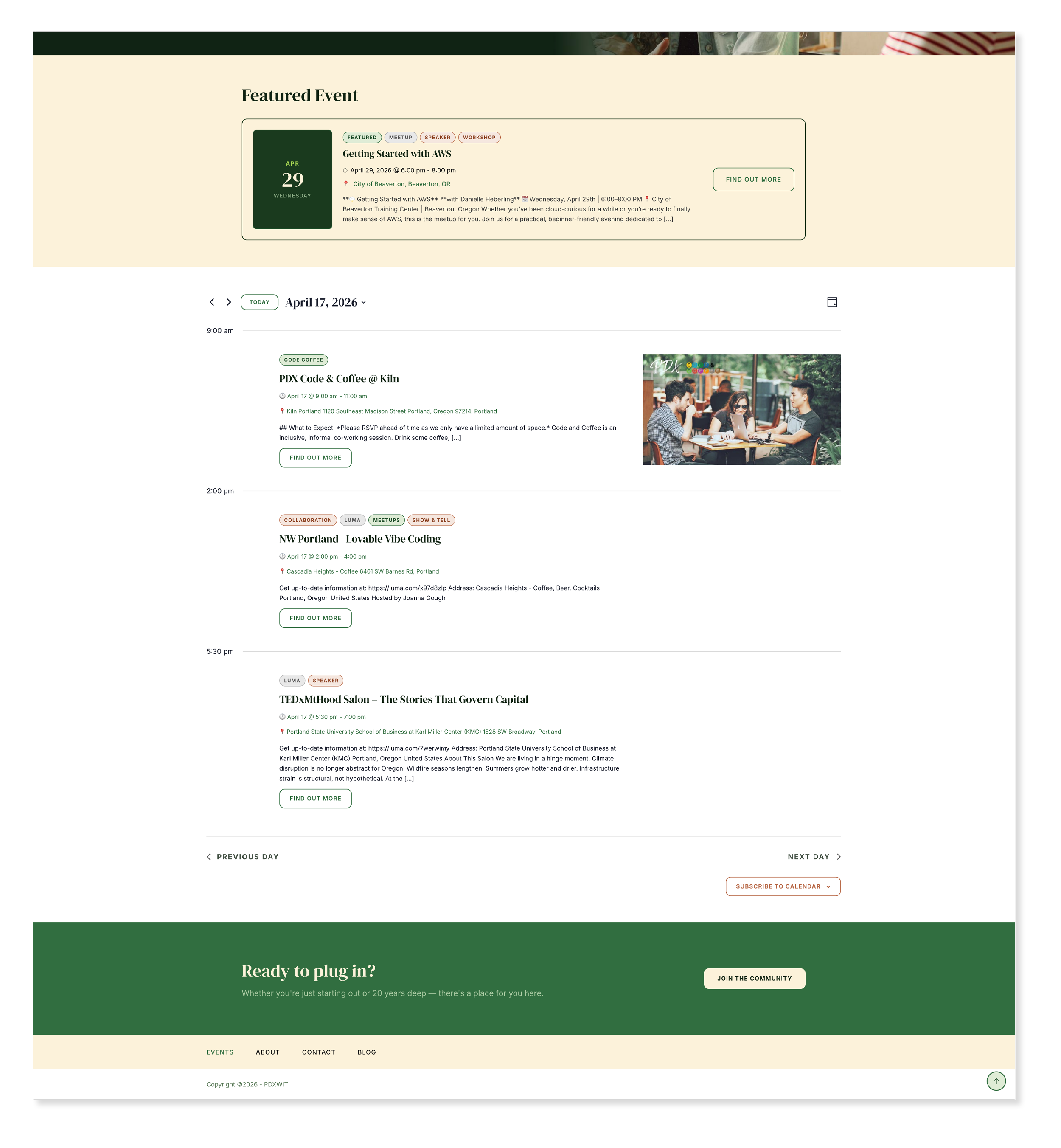
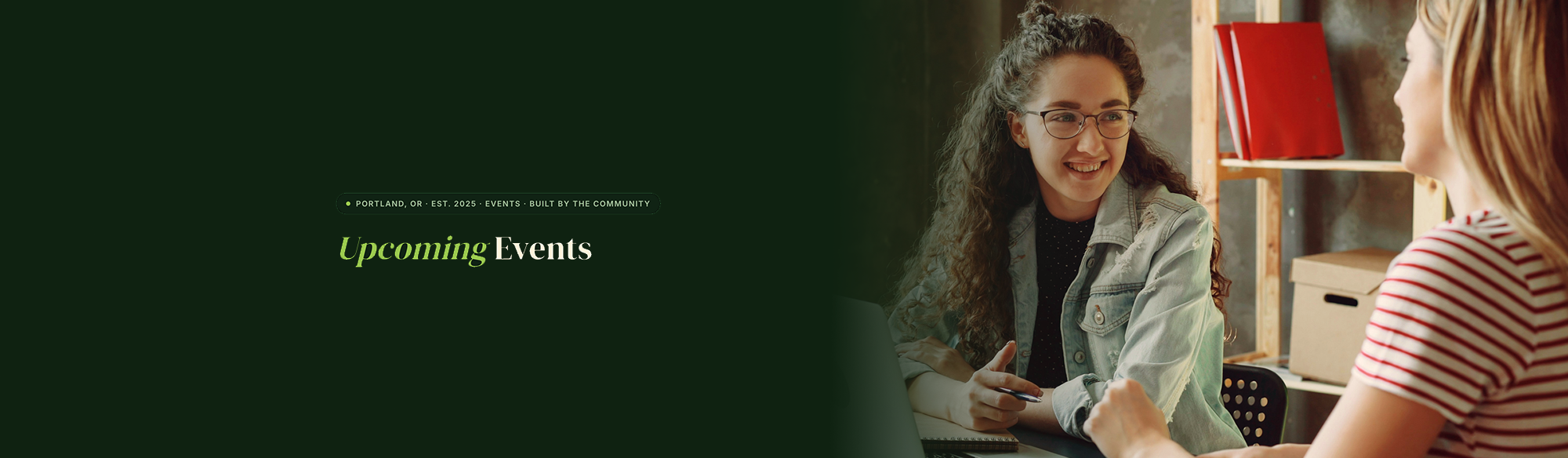
WordPress The Events CalendarThe events system is the heart of the site. Built on The Events Calendar plugin, it supports multiple event types, category filtering, and individual event detail pages — all styled to match the PDXWIT brand. Events can be added and managed entirely by volunteers through the WordPress dashboard.
List View
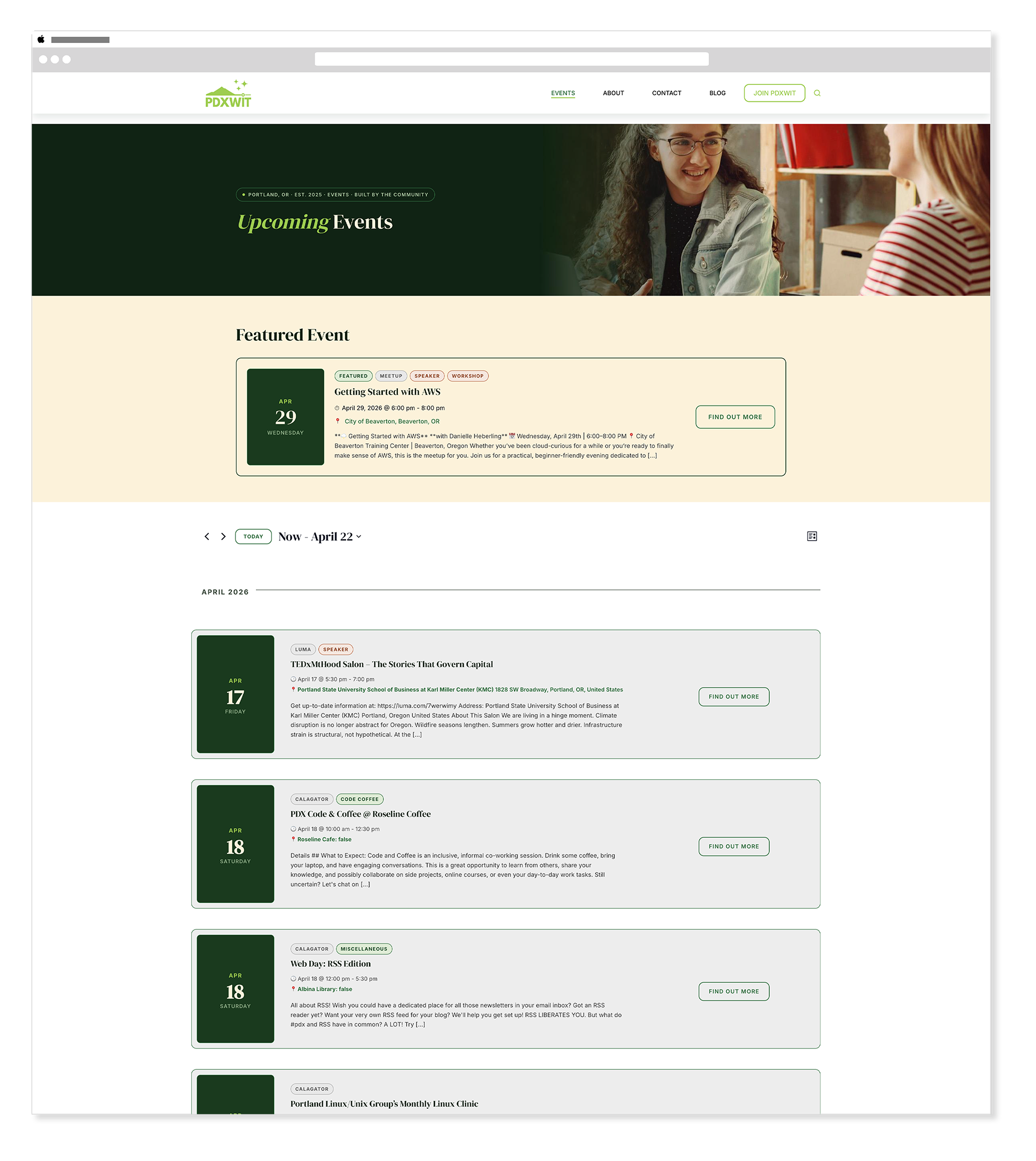
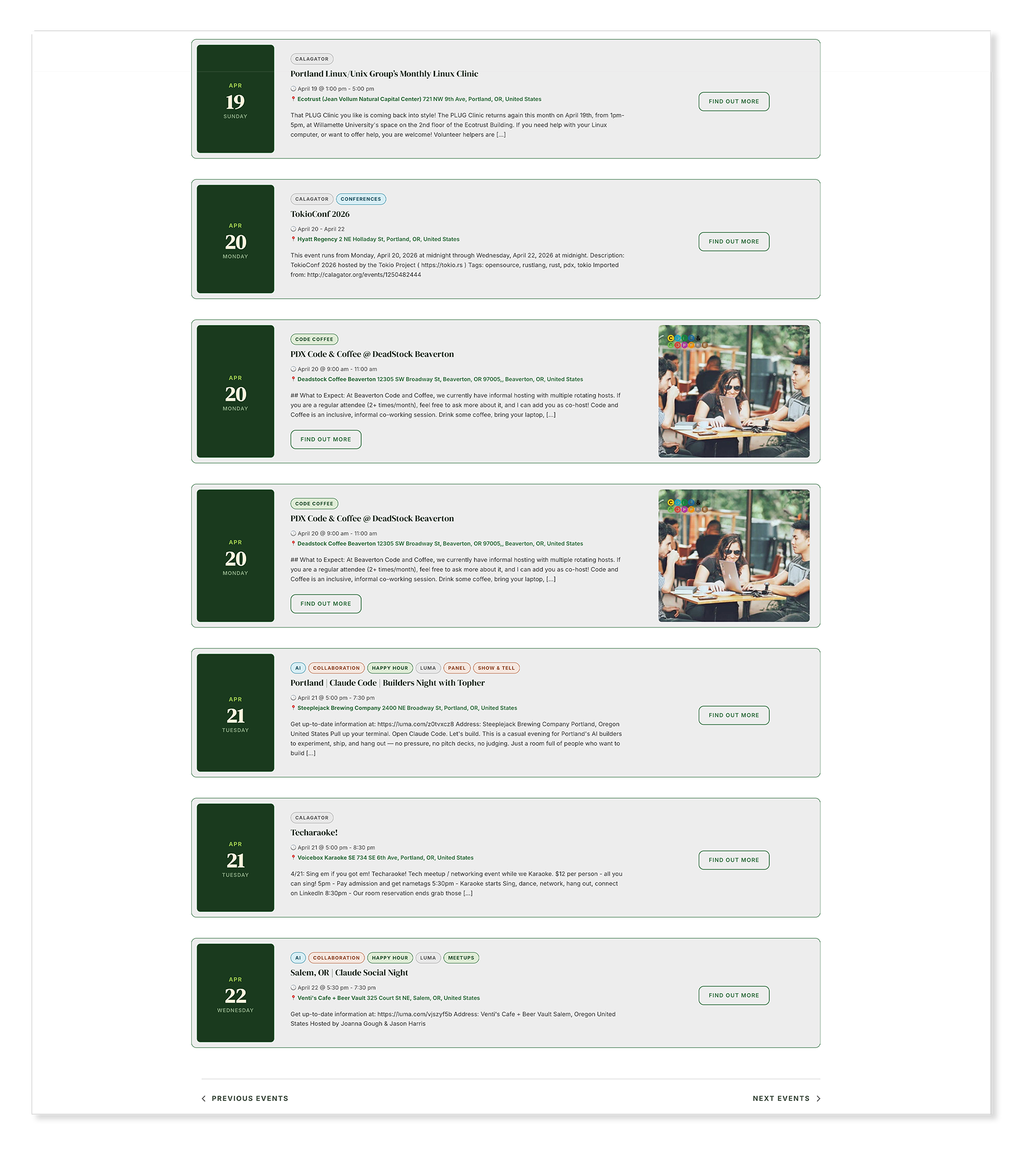
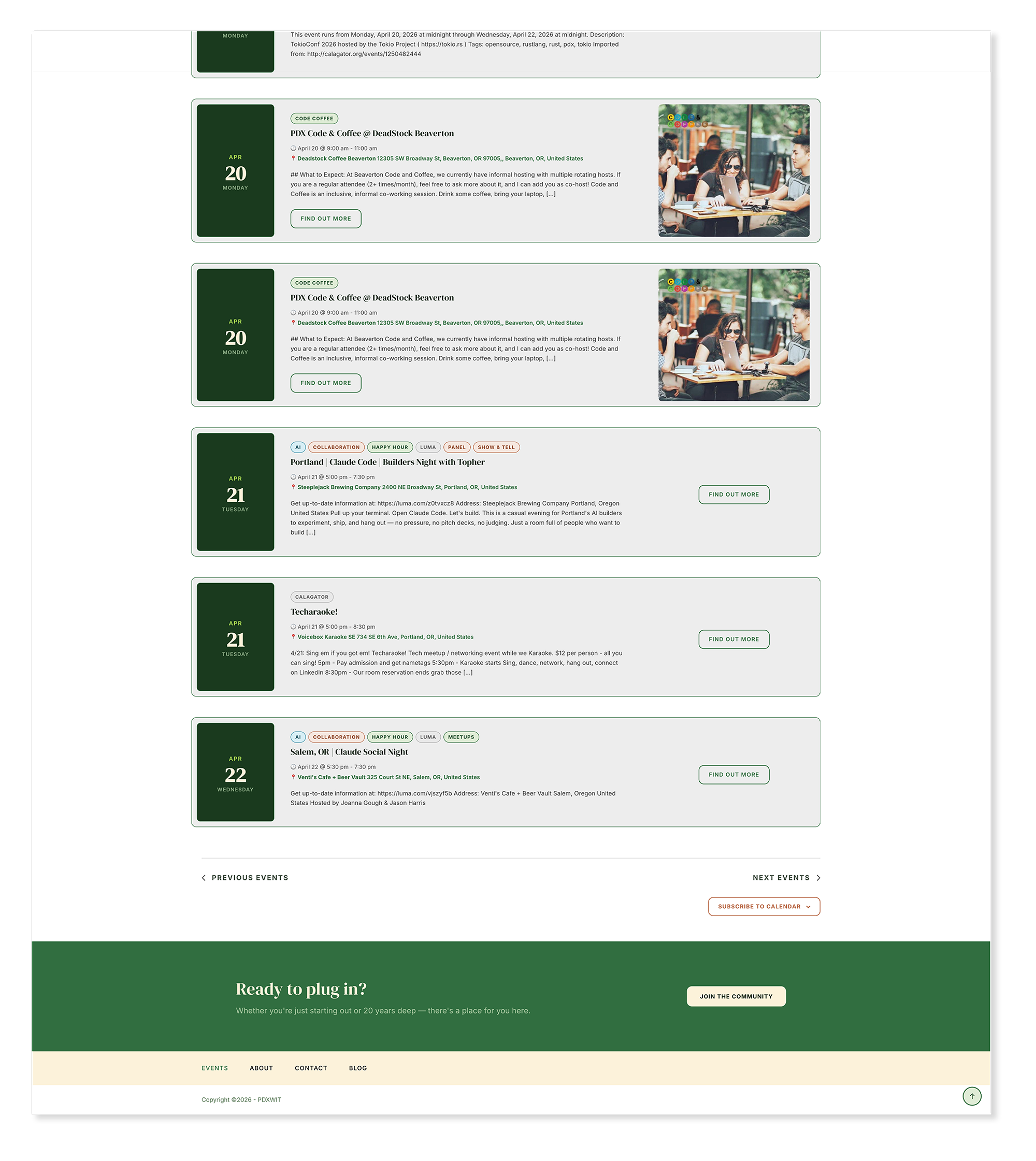
Day View
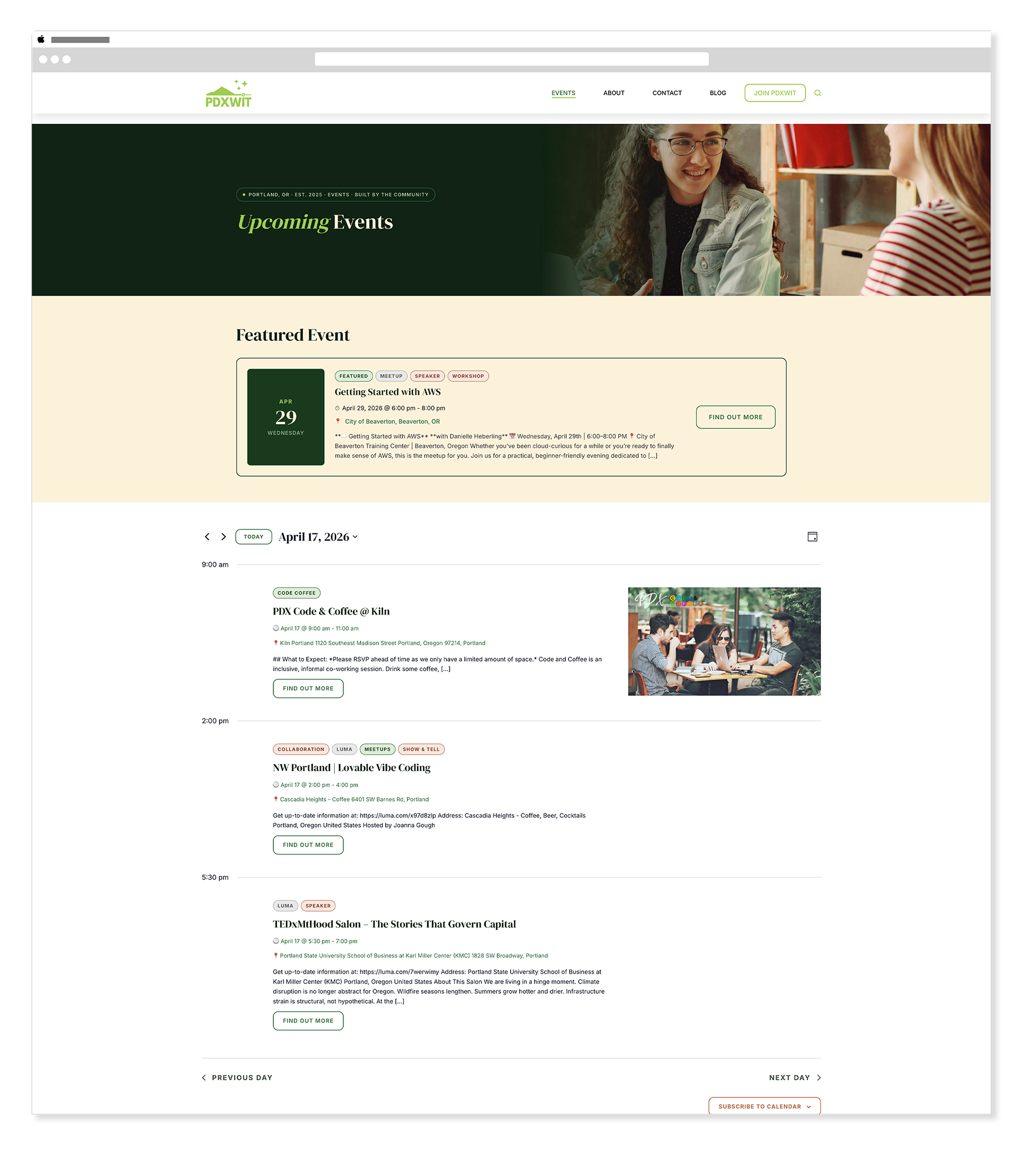
About
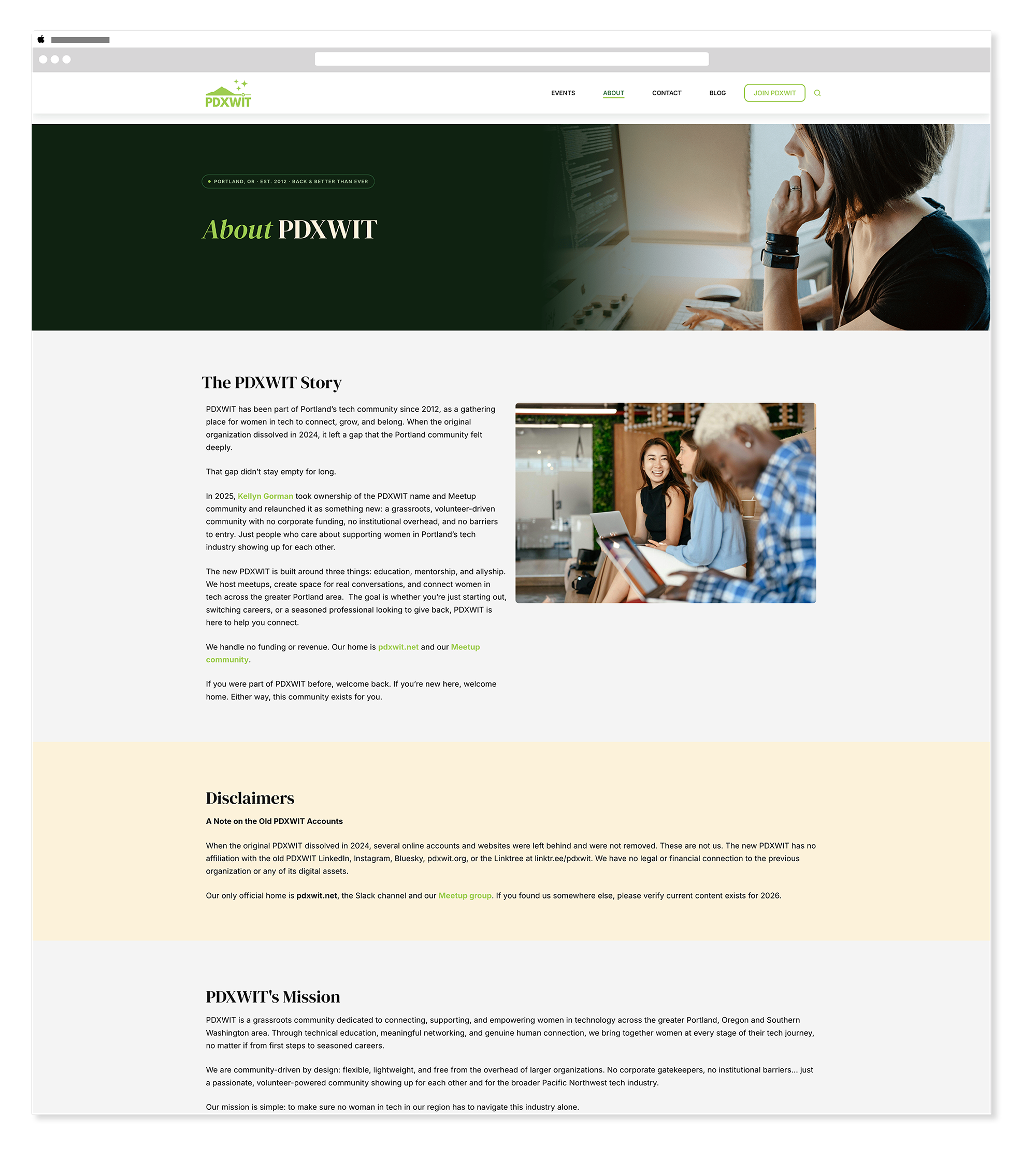
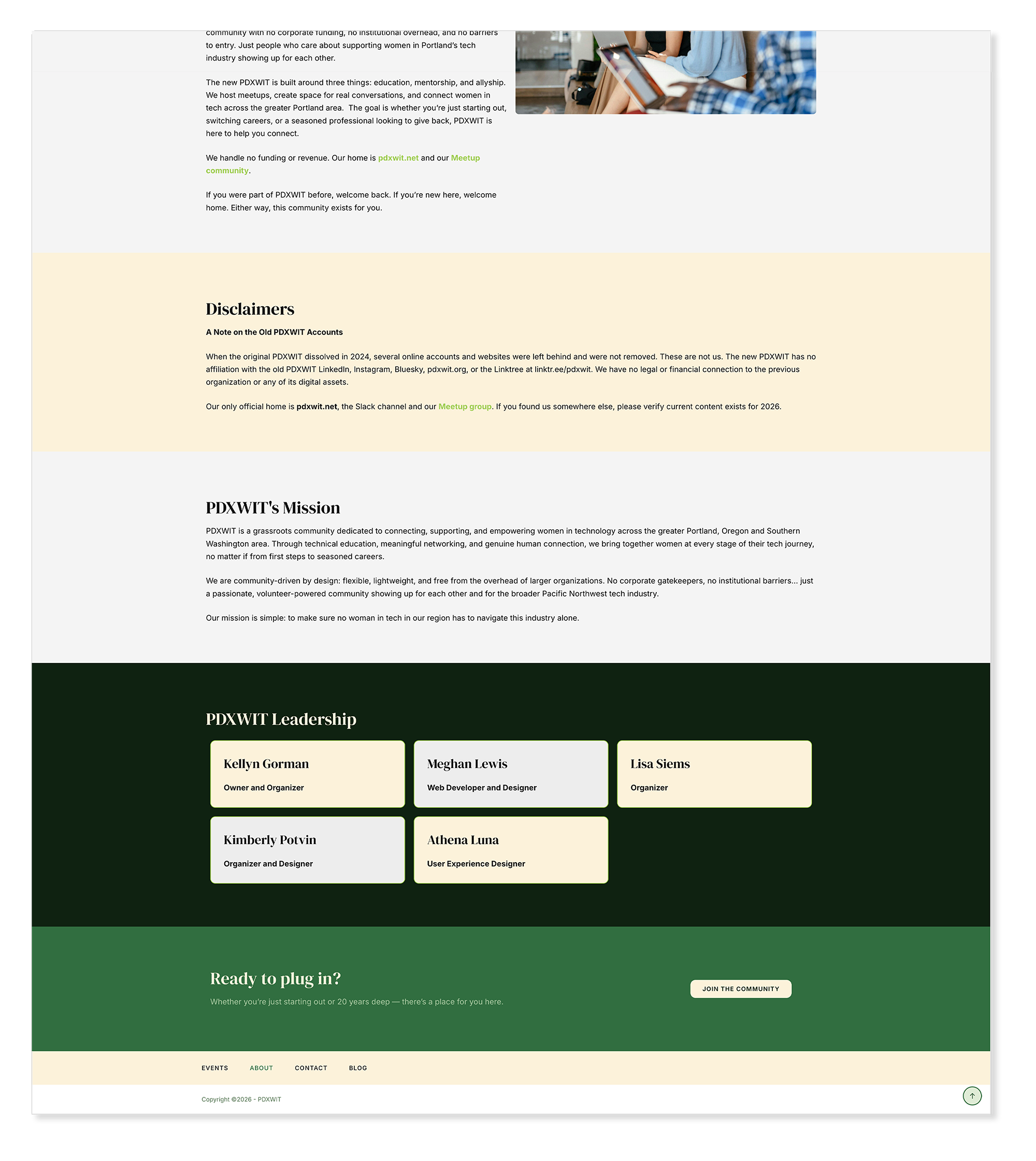
WordPressThe about page communicates PDXWIT's mission, values, and community story — building credibility and trust for first-time visitors while reinforcing belonging for returning members. Clear, warm, and purposefully concise.
Contact
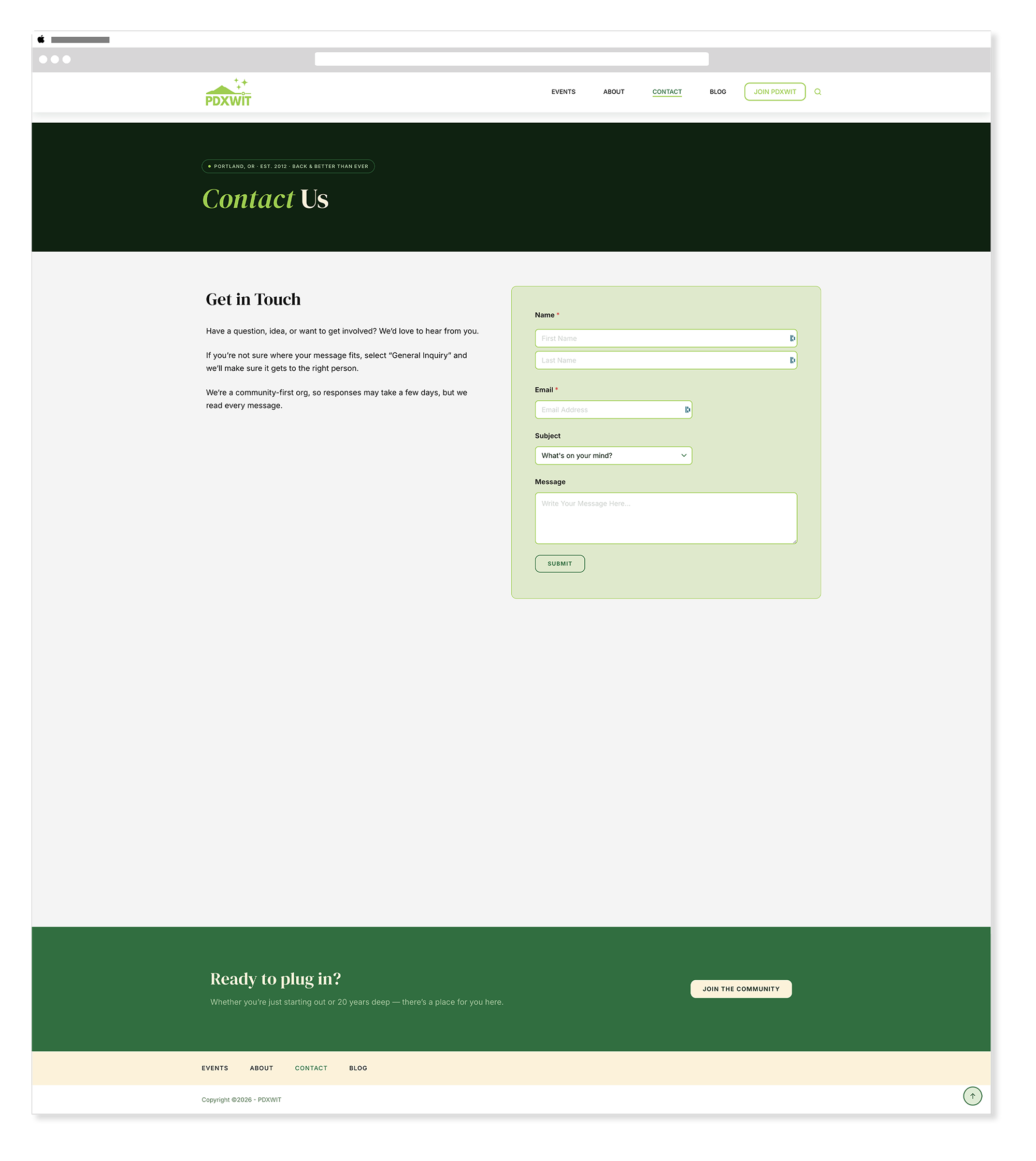
WordPressA clean, low-friction contact page for sponsor inquiries, speaker submissions, and general community questions. Designed to be approachable rather than formal — reflecting PDXWIT's community-first personality.
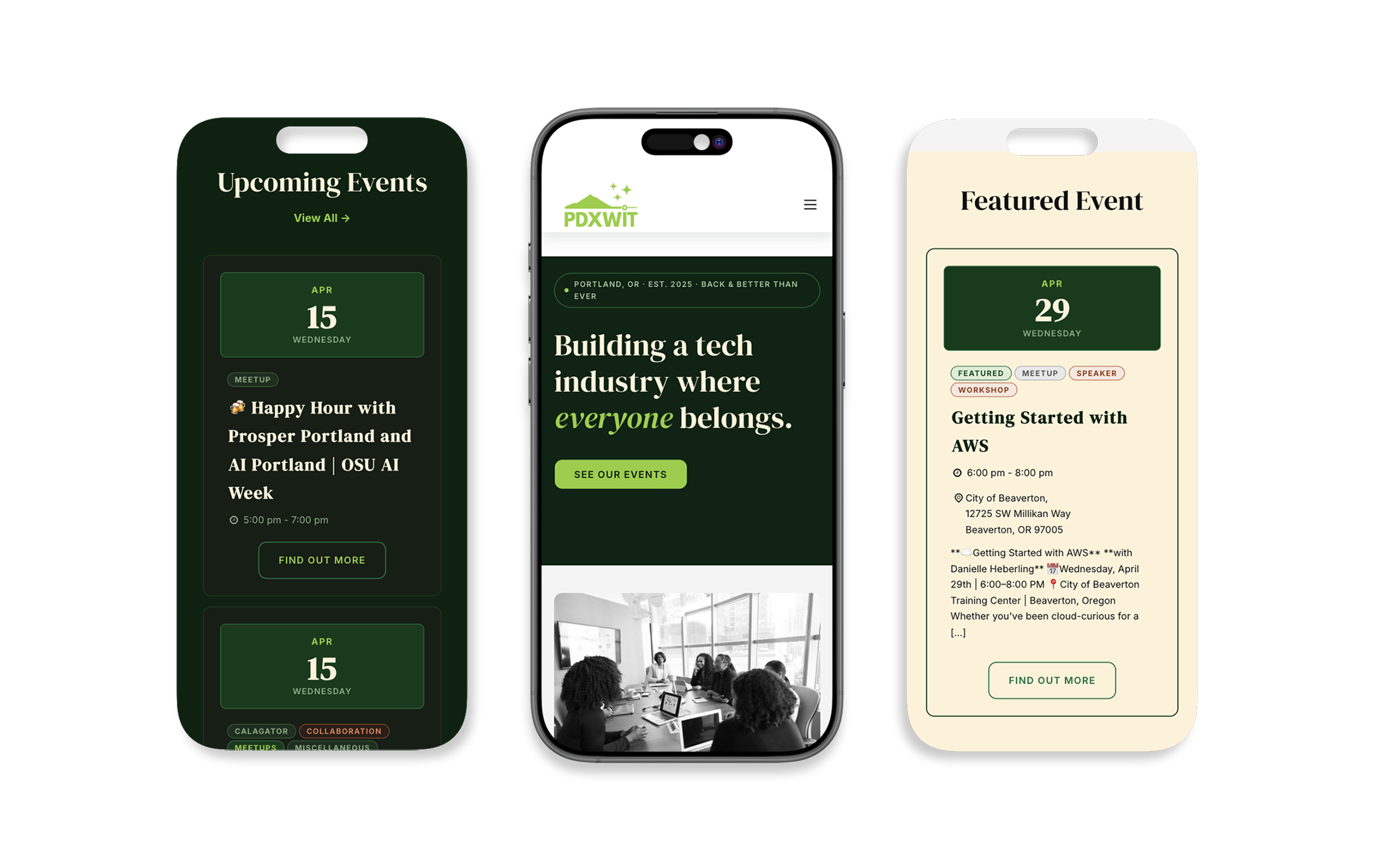
Mobile
ResponsiveThe site is fully responsive — every page adapts cleanly to mobile without sacrificing the brand experience or event discovery flow.
The System
Built to be owned by the community, not just the designer.
A volunteer-maintained site lives or dies by how easy it is to update. The PDXWIT WordPress build was designed with non-technical contributors in mind — reusable page templates, a documented component system, and an event management workflow that anyone on the team can operate without touching code.
Athena's wireframes were the starting point for the component architecture — she brought a systems-thinking approach early in the process that made the build more intentional. Working through the Figma-to-Elementor translation together was one of the more rewarding parts of the project, bridging the gap between design intent and production reality in real time.
Reusable Components
WordPress Custom ComponentsPage sections were built as modular, reusable blocks — hero areas, event cards, community CTAs, and content rows — so new pages can be assembled without custom development work.
What's Coming
RoadmapThe site launched with a clear roadmap of community features in active development — a job board, mentorship matching, speaker submissions, dark mode, and more. The architecture was built to accommodate these additions without requiring a full rebuild.

Outcomes
What this work delivered.
Homepage, Events, About, Contact, and Blog — all live, branded, and maintainable by the volunteer team from day one.
Meetups, workshops, speaker events, and Code & Coffee sessions — all managed through The Events Calendar with category filtering and individual detail pages.
PDXWIT relaunched with a digital presence that reflects where the community is going — not just where it's been.
Reflection
What this work taught me.
This project was a full-circle moment — taking a brand I built seven years ago and bringing it into a completely new context. The biggest challenge wasn't the technical build, it was making decisions that honored the original work while serving the needs of a community that has grown and changed. Working with Athena added another dimension to that — mentoring someone through their first production WordPress build, from wireframes through to Elementor, pushed me to articulate decisions I might otherwise have made instinctively. Her wireframes started the design system conversation, and that foundation carried through to the final site.
The mentorship didn't stop at launch either. When a plugin conflict crashed the backend shortly after launch, Kellyn brought Athena into the thread — and I made sure she stayed looped in through every email that followed. A live production bug is one of the best classrooms there is, and I wanted her to see firsthand how to diagnose an issue, communicate with a client under pressure, and see it through to resolution. That's the part of web work that doesn't show up in Figma.