
I spent the early part of my career in a male-dominated industry, fighting for credibility in rooms that weren't always designed to include me. I fought for my seat at the table, for my ideas to be taken seriously, for my work to speak louder than assumptions about who I was or wasn't.

That fight takes something out of you. And then, somewhere in your 40s, your own body starts to feel like another thing working against you. The brain fog. The mood swings. The muscle soreness that wasn't there five years ago. The sense that something has shifted and no one gave you a manual.
Here's what I wish someone had told me sooner: movement is one of the most powerful things you can do for your brain and body right now. Not as punishment. Not to look a certain way. Because the science is genuinely remarkable — and because for the first time in a long time, this is something that belongs entirely to you.
The Science
What's Actually Happening in Your Brain

Estrogen is not just a reproductive hormone. It plays a significant role in brain health — acting directly on the prefrontal cortex and hippocampus, the regions involved in memory, focus, and decision-making.[1] Its receptors are distributed throughout the brain, meaning when estrogen levels begin to fluctuate and decline during perimenopause, the effects show up cognitively as much as physically.
Brain fog. Word retrieval that takes a beat longer than it used to. A feeling of mental static that wasn't there before.
This is real, it's documented, and it has nothing to do with your intelligence or your capability. Your brain is adapting to a hormonal shift — one that, as researchers at Mayo Clinic put it, doesn't mean the brain gets worse, it just adapts.[2] But how you support that adaptation matters enormously.
The Benefits
Exercise as a Counterforce
This is where movement comes back in — and it goes well beyond the mood boost we covered in the gym/ideas post.
For women in perimenopause, regular exercise has been shown to:
Reduce brain fog and support neuroplasticity. Physical activity increases blood flow to the brain and promotes the growth of new neural connections — the same BDNF response we talked about before, but with particular significance during a period when hormonal support for those processes is declining.[3]
Ease mood symptoms. Declining estrogen and progesterone disrupt the neurotransmitter systems that regulate mood. Exercise stimulates the release of endorphins, dopamine, and serotonin — essentially providing a natural counterbalance to what the hormonal shift is taking away.[4]
Protect bone density. Estrogen helps maintain bone structure. As levels drop, bone loss accelerates. Weight-bearing exercise and resistance training directly stimulate bone formation and help offset that loss.[5]
Support metabolic health. Body composition and metabolism shift during perimenopause in ways that feel frustrating and unfair. Exercise — particularly strength training — helps maintain lean muscle mass and metabolic function in ways that diet alone cannot.
The Case
The Case for Lifting, Specifically
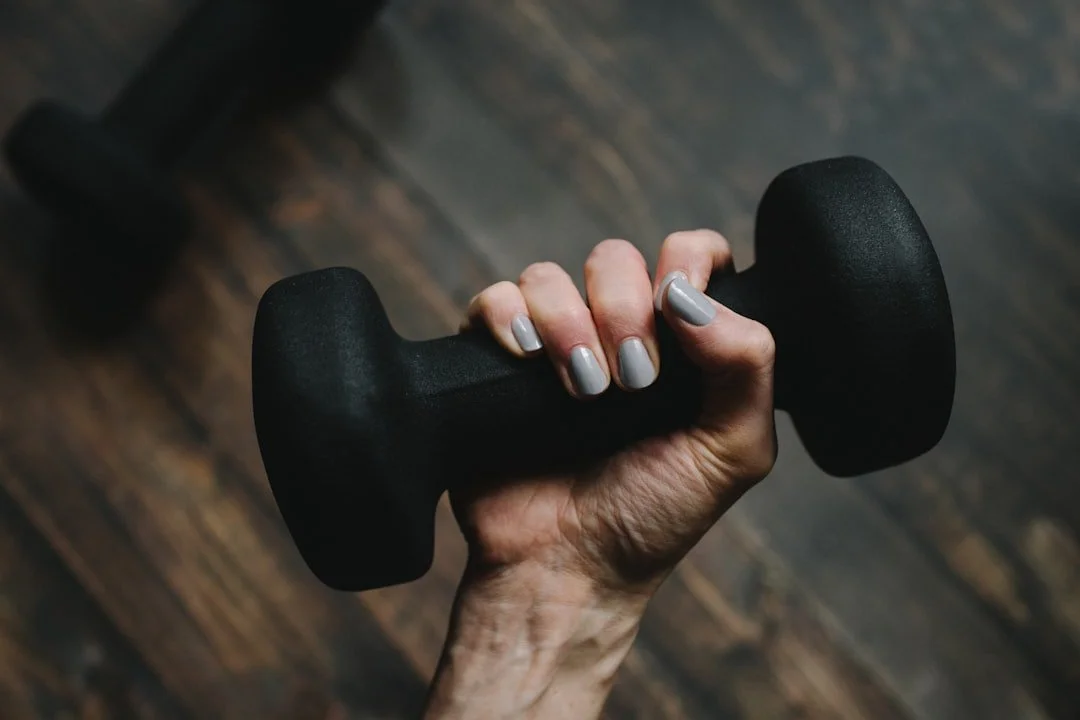
If you're not already doing some form of resistance training, this is the moment to start.
The research on strength training and cognitive health during the menopausal transition is growing — and it's compelling. A clinical study currently underway is specifically investigating whether progressive resistance training can improve cognitive outcomes in perimenopausal women experiencing brain fog and memory complaints.[6] Early evidence points strongly toward yes.
Beyond cognition: muscle mass matters more as we age than most of us were ever told. It's protective — metabolically, structurally, and in terms of long-term independence. Building and maintaining it in your 40s is one of the most forward-thinking things you can do for the decades ahead.
The Bigger Picture
What This Means Beyond the Physical
Here's the part that's harder to put in a research paper but that I think matters just as much.
Movement, especially now, is an act of reclamation.
When you've spent years in environments where your value was questioned, where you had to prove yourself constantly, where the goalposts moved — there's something quietly radical about showing up for your own body. Not for productivity. Not for anyone else's approval. Just because your body is yours, and it deserves the same investment of energy you've given to everything and everyone else.
The gym doesn't care about your experience level or your gender or what year you graduated. The weights don't have opinions about you. The treadmill will meet you wherever you are today. In a career where I've had to fight for every inch, there's something deeply satisfying about a space where the only thing that matters is whether you showed up and did the work.
The Permission Slip
You Don't Need to Have It All Figured Out

I'm not a doctor, a personal trainer, or a menopause specialist. I'm a designer approaching 50 who lifts weights, goes for walks, and pays attention to how her brain and body respond. What I know is that on the days I move, I think more clearly, feel more like myself, and carry the noise a little more lightly.
The science backs that up. But honestly, the lived experience is enough.
If you're in this season and it feels harder than it used to — physically, mentally, professionally — movement won't fix everything. But it will give you something back. And right now, that matters.
This post is part of an ongoing series on creativity, process, and the reality of working as a designer. If it resonated, I'd love to hear from you.
- Mayo Clinic News Network. "Taking a Closer Look at Menopausal Hormone Therapy and Cognitive Health." newsnetwork.mayoclinic.org ↑
- Ibid. ↑
- The Women's Clinic. "The Hidden Benefits of Exercise During Perimenopause." thewomensclinic.co.uk ↑
- Ibid. ↑
- Hinge Health. "Best Exercises for Menopause: 5 Types and How They Help." hingehealth.com ↑
- ClinicalTrials.gov. "Exercise in Perimenopause to Improve Cognitive Health." clinicaltrials.gov ↑
Further Reading
Go Deeper
- Harvard Health — "Menopause and Memory: Know the Facts": health.harvard.edu
- Frontiers in Molecular Biosciences — Estrogen, menopause, and Alzheimer's disease (2025): frontiersin.org
- PMC — Effects of mind-body exercise on perimenopausal and postmenopausal women (meta-analysis): pmc.ncbi.nlm.nih.gov
- Anytime Fitness — Menopause, hormones, and exercise across every stage: anytimefitness.com
