
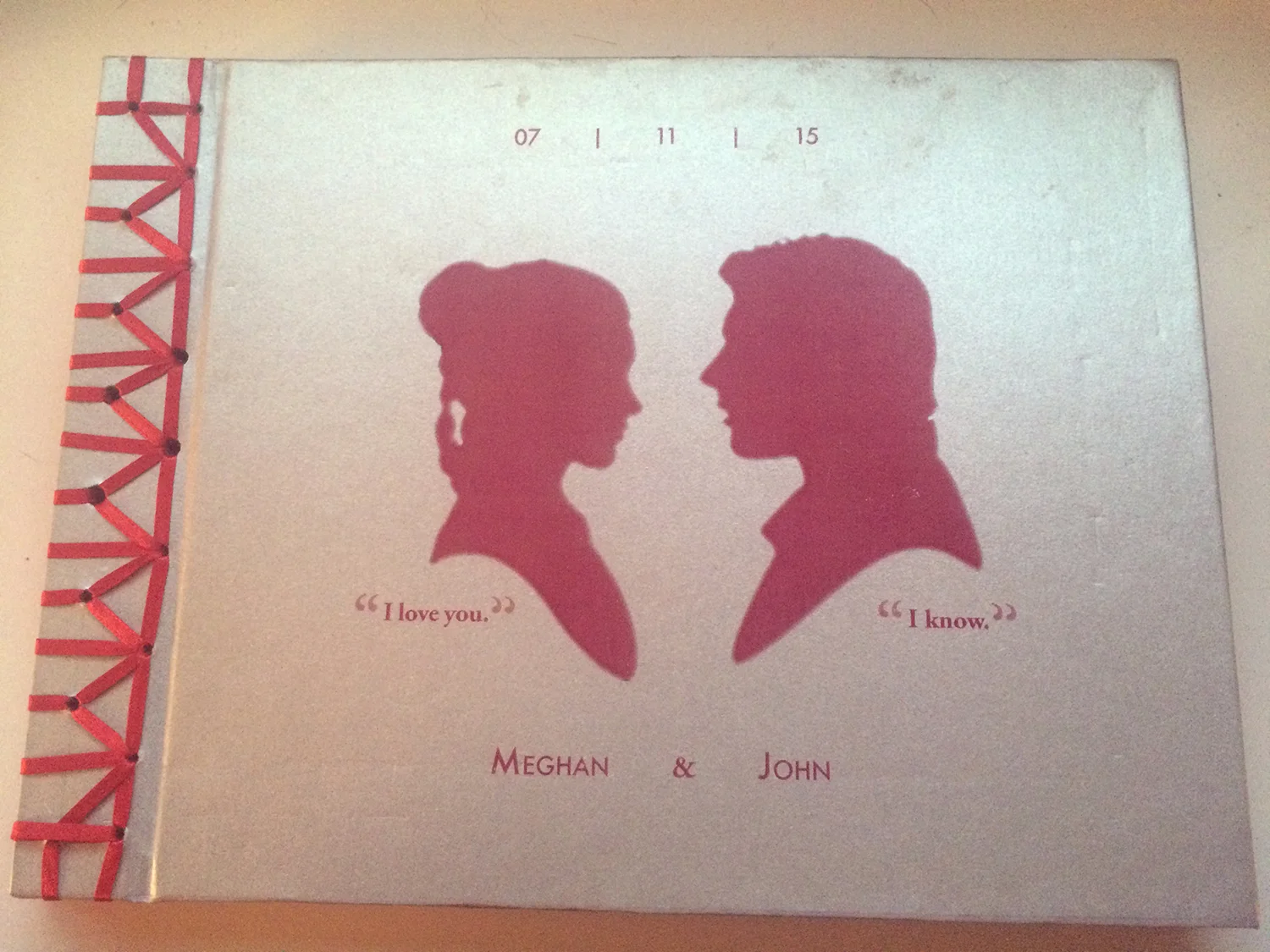
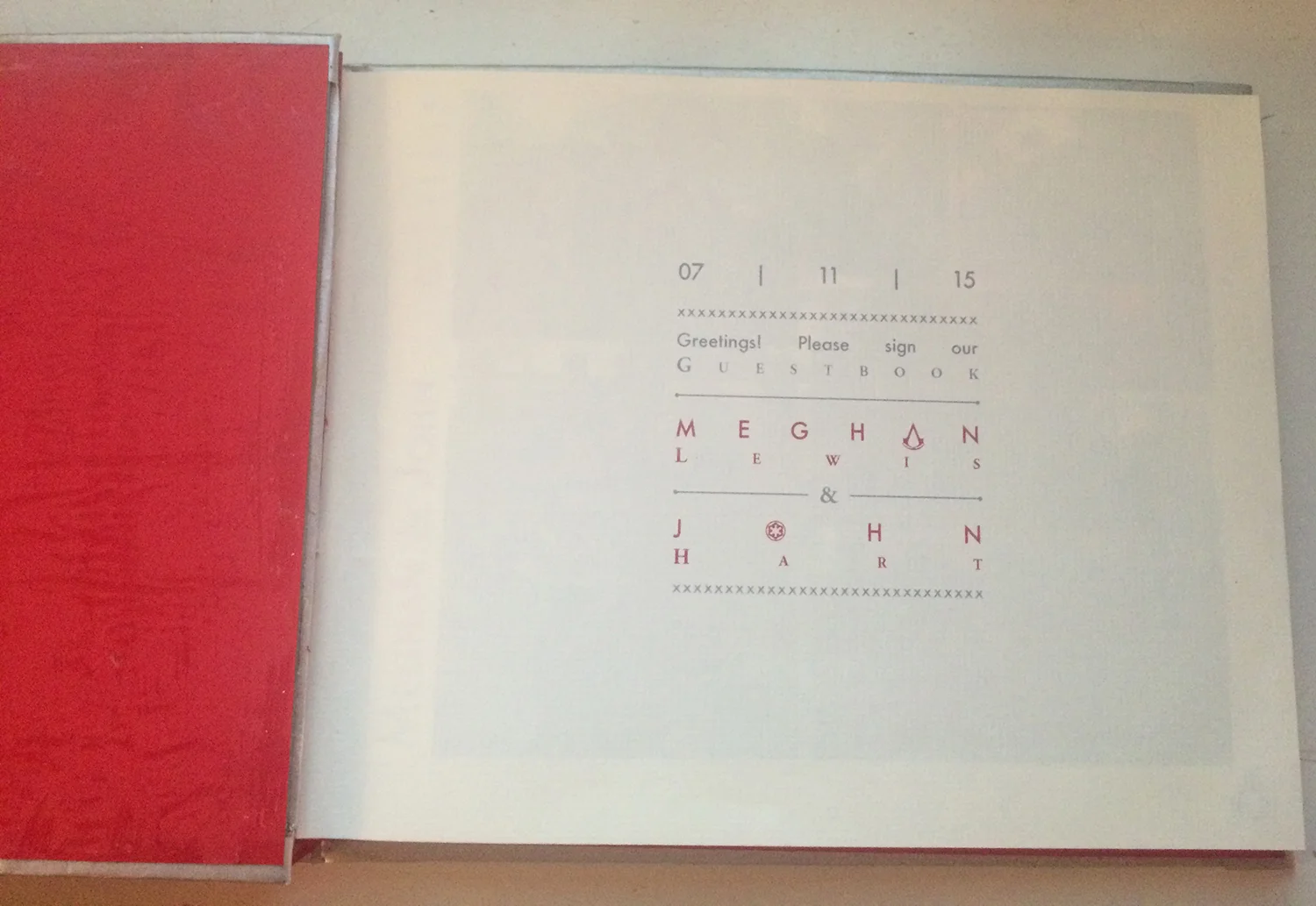
When you can't find the perfect guestbook, you make one. And when your wedding theme is Star Wars meets Assassin's Creed, "the perfect guestbook" is definitely not something you'll find at a store.
Traditionally, a wedding guestbook was used to document and record guests as they arrived so the bride and groom could easily send thank you notes. It's also been used as a way to gather contact information from family and friends who you may not see often.
I scoured bookstores and craft stores for something that fit our aesthetic — and came up empty. Anything unique enough would have cost a fortune to have made. So I did what any designer with bookbinding experience would do: I made it myself. Using previous bookbinding experience and print design skill, I set to work creating something completely unique to us. The book was a success and looked beautiful on display at our reception on July 11, 2015.
The Concept
His galaxy. Her Renaissance Italy. One book.
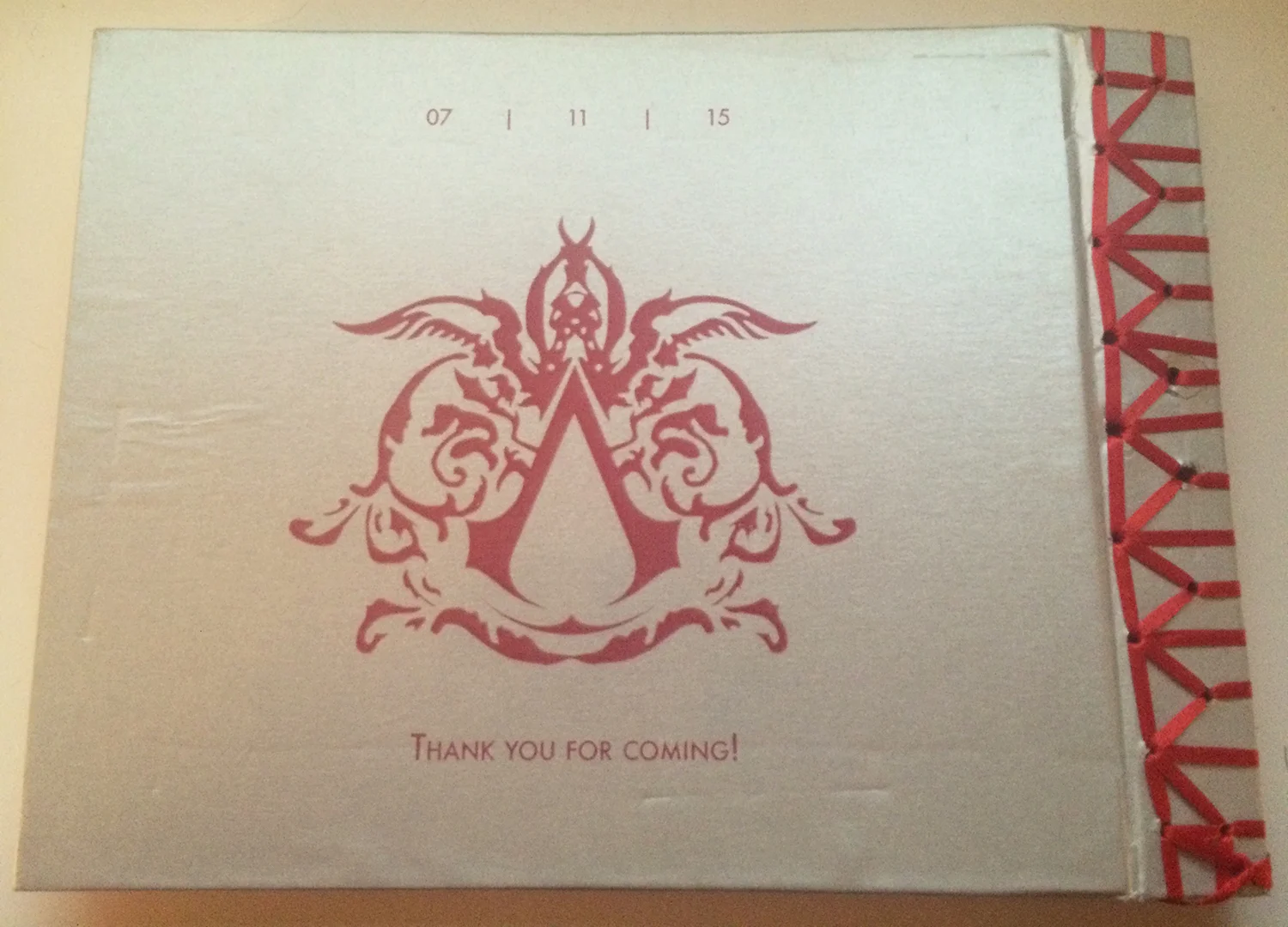
Our wedding aesthetic brought together two very different fandoms — John's love of Star Wars and my obsession with Assassin's Creed. Finding a way to make those two worlds feel cohesive rather than chaotic was the real design challenge. The solution was to let each aesthetic live in its own space while keeping the overall design language — the typography, the layout, the materials — unified throughout.
The result was a book that felt completely personal. Not a store-bought prop, but something made specifically for the two of us and the day we were celebrating.
The Technique
Japanese Stab Binding — a centuries-old technique that's perfect for guestbooks.
Japanese Stab Binding (also called Yotsume Toji — roughly "four holes" in Japanese) is a traditional bookbinding method that dates back to at least the Edo period in Japan (1603–1867). Historical context sourced from StencilGirl Talk.
The technique involves sewing single sheets of paper together through holes punched along the spine — no adhesive required. The exposed spine becomes a design element in itself, with the thread pattern visible on the outside of the book. The basic Japanese version produces a book with a spine that does not allow the book to be laid flat, which gives it a distinctly handcrafted, precious quality — exactly right for a keepsake.
Prepare the pages. Cut all paper to uniform size. For a guestbook, a heavier weight paper works best — it holds up to handling and gives the book substance.
Punch the holes. Mark evenly spaced holes along the spine edge — four holes is the traditional Japanese pattern. Every layer of paper and the covers all need to be punched identically so the thread passes through cleanly.
Sew the binding. Thread passes through each hole in a specific pattern, wrapping around the spine and each end. The result is a visible, decorative stitch on the outside of the book that holds everything together without glue.
Finish the covers. The covers can be made from bookboard, cardstock, fabric, or decorative paper — in this case, custom-designed and printed to reflect our wedding theme.
The Result
A guestbook worth keeping.
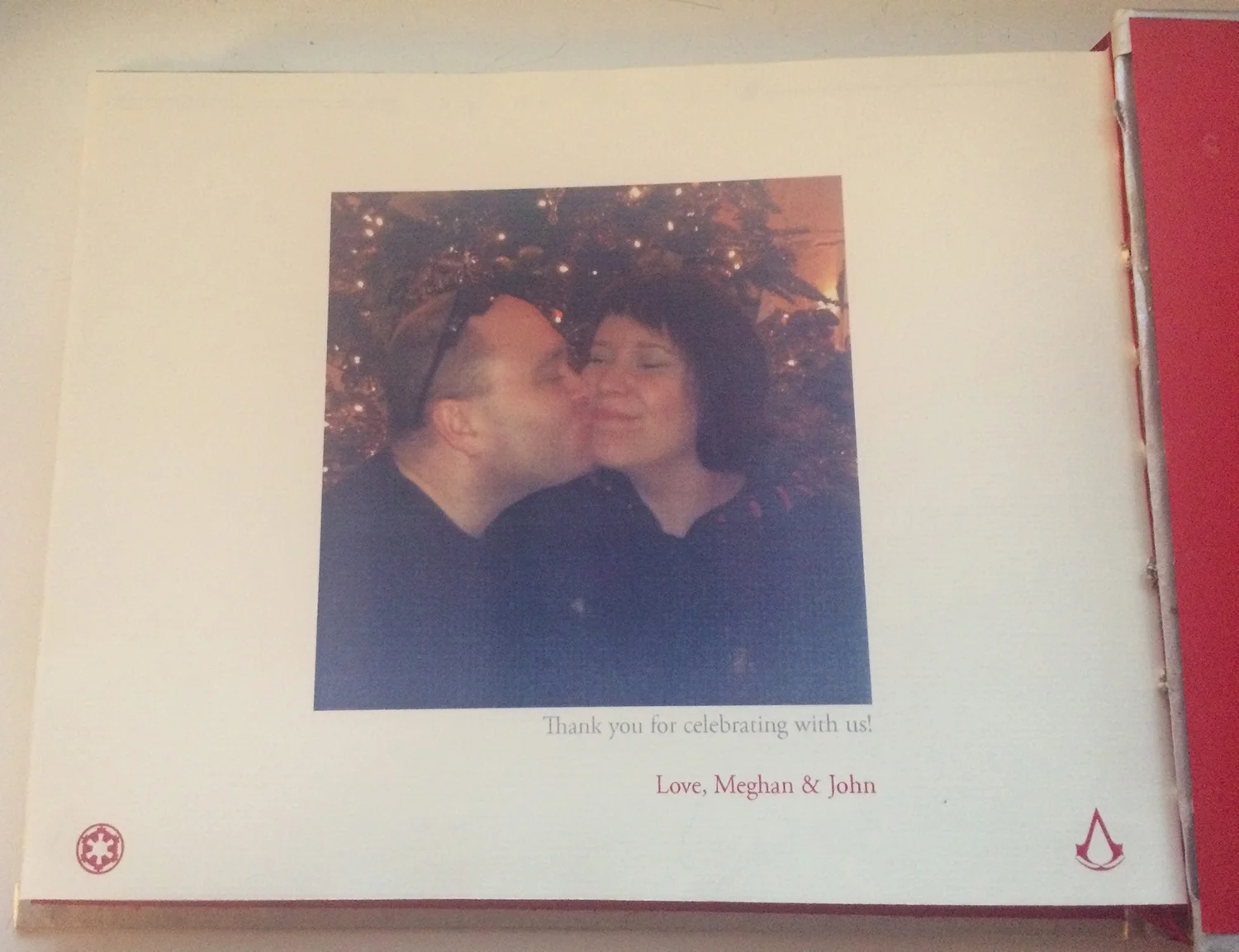
The finished book was displayed at our reception and guests signed it throughout the evening. It now lives on our bookshelf — not in a box somewhere, but actually on display, because it looks like something worth looking at.
It was also a good reminder that when you can't find the thing you're looking for, you have the skills to make it. Sometimes the best design brief is the one you write for yourself.
References
Further Reading
If you're interested in trying Japanese Stab Binding yourself, these are some good starting points:
